
We tried Claude for Metabase this week, asking it to pull daily new customers and CAC over the last 30 days for paid channels only. What came back in seconds was clean, interactive, and 95% right.
Signal
You are getting fast answers from AI tools but are not sure whether to trust them, and you have no reliable way of knowing whether the result is right.
Stakeholders
Data Team Leads, Heads of Growth, Marketing Analysts, Founders considering AI for reporting.
Strategy
Before you hand AI the keys to your data, make sure the foundations are actually solid.
Introduction
We tried Claude for Metabase this week. We asked a simple question: “Show me daily new customers and CAC over the last 30 days, paid channel only.” In seconds, we got a clean dashboard, a well-written analysis, and something that looked 95% right.
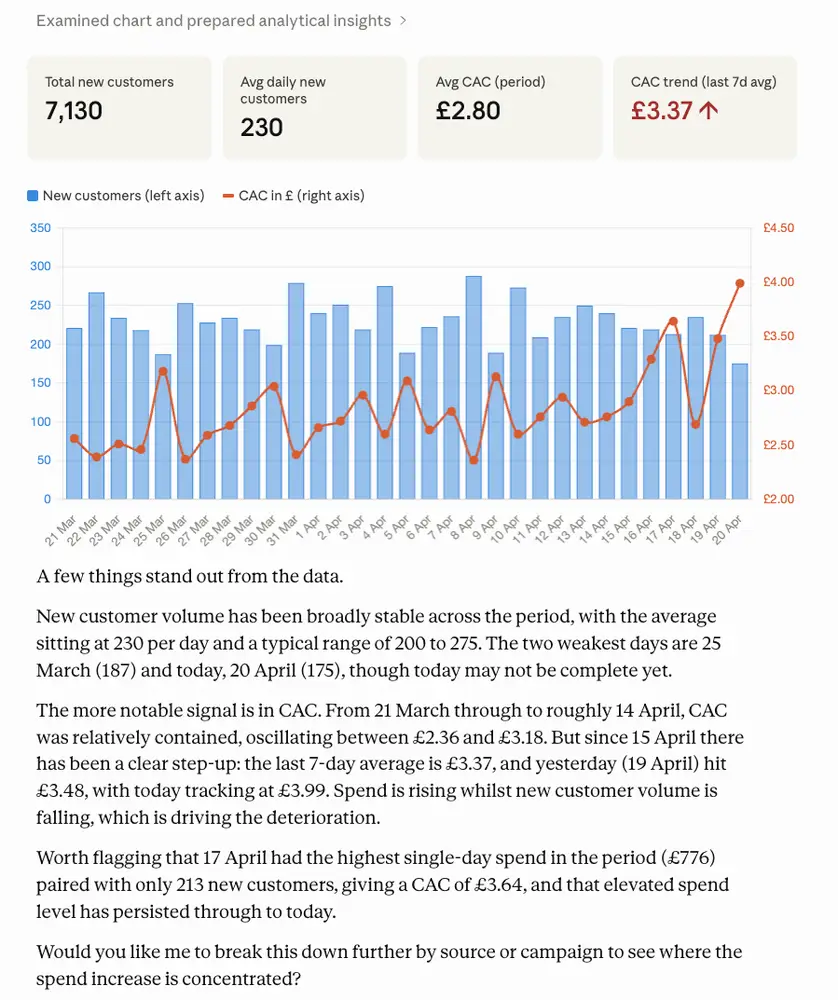
The result was genuinely good. Clear, interactive, and immediately usable. The analysis picked up the key signal without being prompted: CAC had been creeping up since mid-April whilst spend was rising and new customer volume was falling. That is exactly the kind of deterioration you want flagged early. It even offered to go deeper by source or campaign. And it all came back faster than most teams could even open their BI tool.
So naturally, the question: do we still need data teams?
Here is how Claude got there, because the real story is not in the chart. It is in the steps.
What Claude Actually Did
Most people see the chart and assume Claude just knew what to do. It did not. It reasoned its way there, step by step.
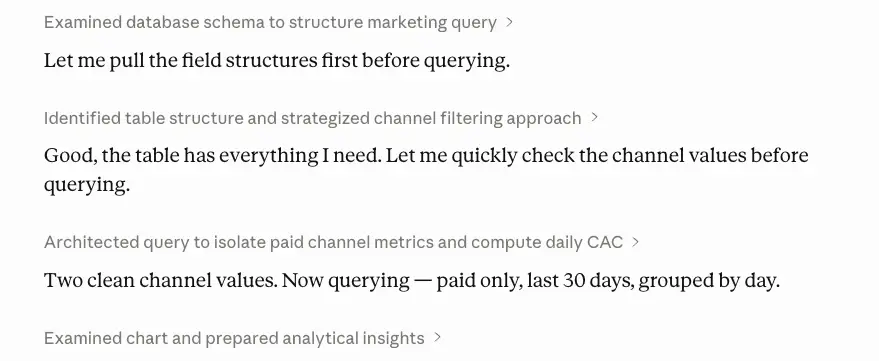
Step 1: Examine the schema first. Claude did not jump straight to querying. It pulled the table structure first, identified the right table, confirmed the fields it needed, and chose to compute CAC from those components.
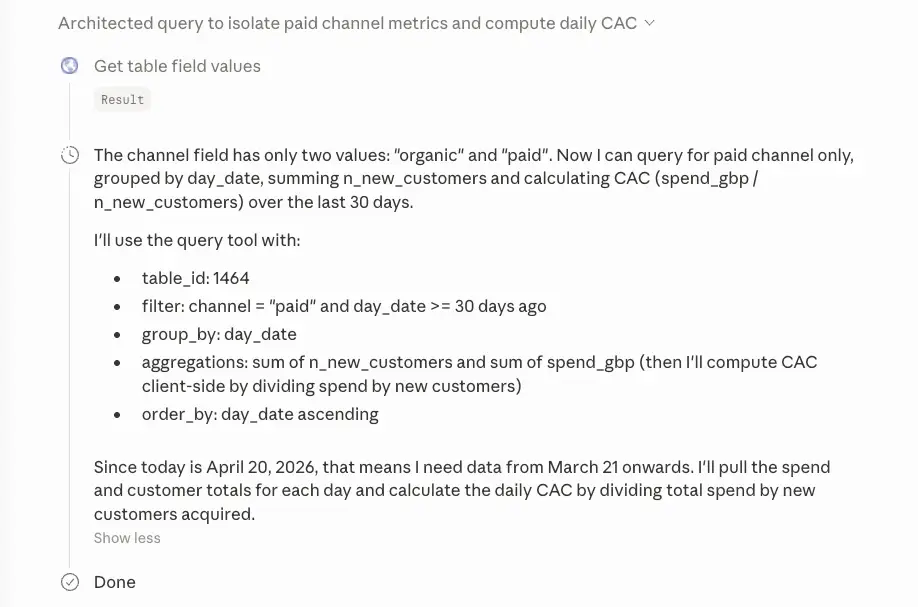
Step 2: Check the channel values before filtering. Rather than assuming what “paid” looked like in the data, Claude queried the distinct values of the channel field first. Two values: organic and paid. Clean. This matters more than it looks. In messy real-world data, channel fields often contain a dozen variations: “Paid”, “paid_social”, “PAID”, “meta_paid”. Querying without checking first is how you silently exclude half your data.
Step 3: Build the query properly. With the schema confirmed and channel values known, Claude constructed the query: table 1464, channel = paid, last 30 days, grouped by day, summing spend and new customers, then computing CAC by division. No guessing. No assumptions. Methodical.
Step 4: Return the chart and the analysis. The output was clean, interactive, and came with a written analysis that flagged the key signal unprompted. Genuinely impressive
Why Was It So Fast?
Here is the honest answer.
Claude moved quickly because the data was ready for it.
The table was clearly named. The fields were labelled. The channel values were clean. The CAC logic was unambiguous.
Our team built that. Not Claude.
The weeks of work defining what a new customer means across teams, standardising spend from Meta, Google and other channels, attributing correctly via GA4, modelling everything into a single clean table: that is what made a 10-second answer possible.
Claude did not do any of that. It simply found a well-organised room and described what was in it.
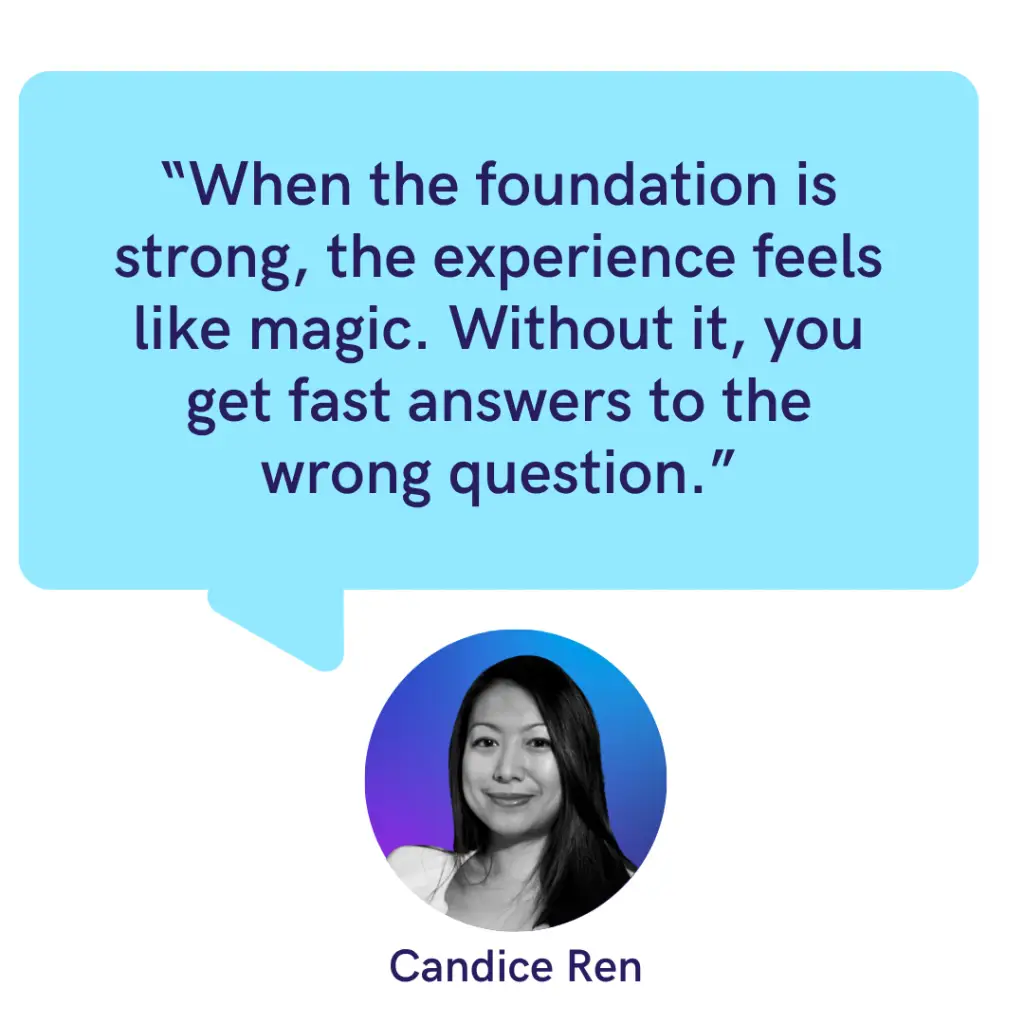
When the foundation is strong, the experience feels like magic. Without it, you get fast answers to the wrong question.
Expert help is only a call away. We are always happy to give advice, offer an impartial opinion and put you on the right track. Book a call with a member of our friendly team today.
So Do You Still Need A Data Team?
Yes. More than ever.
Because the bottleneck is shifting:
- From getting data → to trusting data
- From building dashboards → to defining business logic
- From writing SQL → to designing systems that AI can safely use
AI will absolutely compress the last mile, but it amplifies any weakness upstream:
- Inconsistent definitions
- Poor modelling
- Missing governance
This is not “AI replaces data teams”. It is:
AI makes good data teams 10x more impactful, and bad ones dangerously exposed.
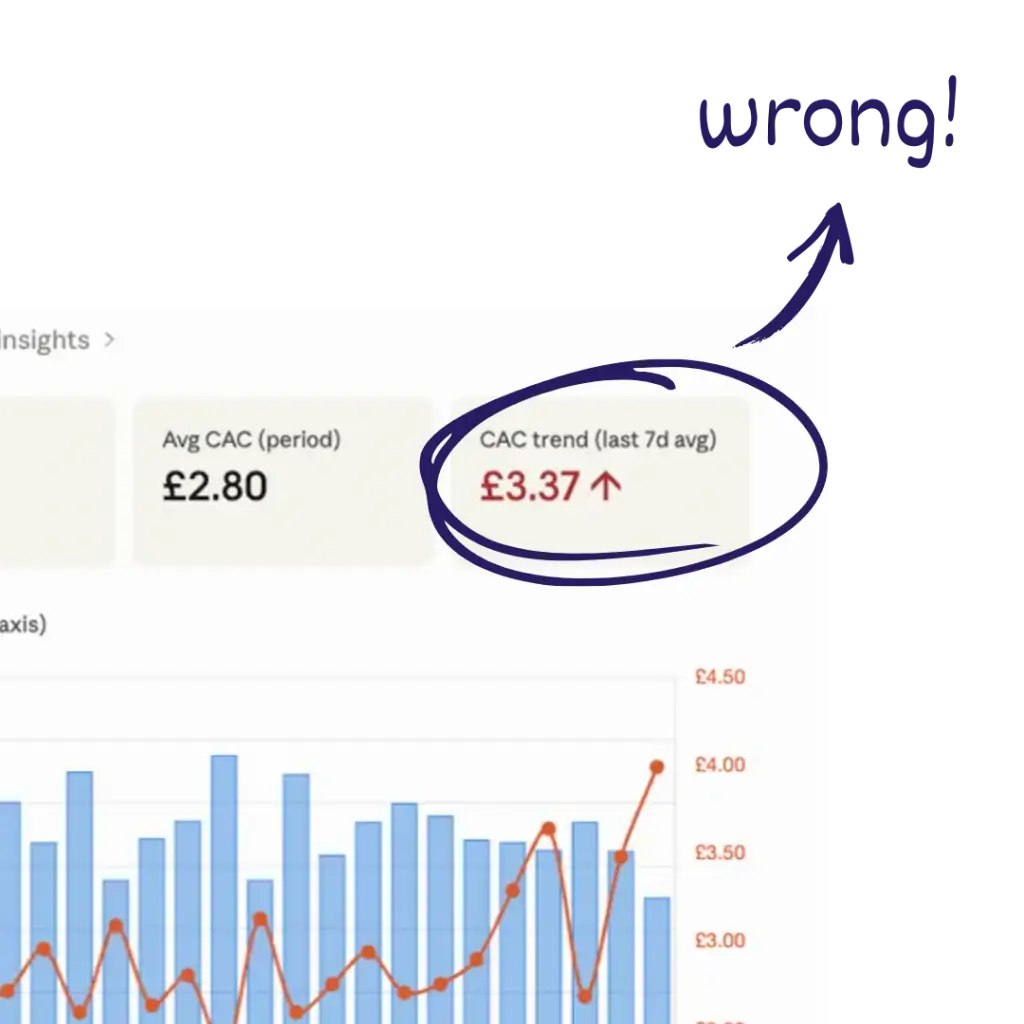
And one last thing: The CAC average is wrong here and Claude did not know it! When questioned, it did realise that it had made a mistake but could not recall how this metric was calculated.



































Conclusion
We said 95% accurate, not 100%. That gap is small enough to look convincing and large enough to cause real problems, and it is exactly the kind of gap that only someone who understands the data can spot.
AI did not close that gap. It could not. That is the shift happening right now in data. The bottleneck is no longer getting answers. It is knowing whether to trust them. The teams that will get the most from AI are not the ones moving fastest. They are the ones who built the right foundations first, and who have the expertise to know when a 95% answer is good enough and when it is not.
If you want to get your data ready for AI then 173tech have the hands-on experience in this field. Let us get you there faster.
Get In Touch
Our friendly team are always on hand to answer questions, troubleshoot problems and point you in the right direction.
