Acquisition & Activation For Subscription Businesses
The subscription business model creates a fundamental paradox: you must acquire customers before you can demonstrate value, yet customers increasingly expect to experience value before committing to pay. This tension between acquisition (getting customers to start) and activation (getting them to experience value) determines whether your business builds a foundation of engaged, retained customers or churns through signups who never discover why they should stay.
Most companies obsess over acquisition volume; driving more traffic, generating more leads, increasing signup rates, whilst treating activation as an afterthought. The result is leaky funnels where 60-80% of signups never experience core value, trial users abandon before conversion, and first-month churn devastates what appeared to be successful acquisition campaigns. The brutal mathematics of subscription businesses means that poor activation destroys the economics of even the most efficient acquisition engines.
Why These Stages Are Critical
The subscription model’s defining characteristic is recurring revenue, which relies on ongoing customer relationships rather than one-time transactions. This makes the quality of customer acquisition and their initial experience extremely important compared to traditional business models.
Early Success Means Later Success: Early-stage customer experience determines lifetime value. A customer who activates successfully; experiences core value within their first days or weeks, typically retains at 85-95% annually. A customer who never activates retains at 20-40%. This difference compounds dramatically over time. After three years, the activated customer has likely generated 10-15 times more revenue than the non-activated customer who churned early. The practical implication is that activation rate is often more important than acquisition volume for determining business growth and profitability. Doubling your activation rate from 30% to 60% has identical impact on activated customer volume as doubling acquisition volume, but dramatically different cost implications. A business acquiring 1,000 signups monthly with 30% activation produces 300 activated customers. Doubling acquisition to 2,000 signups at consistent 30% activation produces 600 activated customers but requires twice the acquisition spend. Customers who activate don’t just retain better in month one; they retain better throughout their lifecycle because they’ve established usage patterns, achieved outcomes, and integrated your product into workflows. The customer who experiences value in week one is dramatically more likely to still be a customer in year three than the customer who took three months to discover value.
The Importance Of Providing Value: High activation rates enable stronger word-of-mouth and viral growth because activated customers are satisfied customers who refer others. They provide better testimonials, case studies, and reviews that support acquisition. They are more willing to participate in expansion opportunities like user conferences or community forums that attract prospects. Conversely, poor activation creates negative feedback loops. Churned customers who never experienced value write negative reviews, warn others away, and damage brand perception. They increase acquisition costs by creating market scepticism that requires more aggressive marketing to overcome. They provide no referral or viral growth, forcing dependence on paid acquisition that becomes increasingly expensive as you saturate addressable markets.
The message is clear. Subscription businesses should typically invest heavily in activation (perhaps more heavily than in acquisition) until activation rates reach levels (60-70%+) where further improvements show diminishing returns. Only then should acquisition scaling become the primary growth lever. Many companies do precisely the opposite, scaling acquisition aggressively whilst activation remains mediocre, creating expensive churn treadmills where growth requires ever-increasing acquisition spending.
Measuring Signups
Signup measurement traditionally focuses on volume; how many people registered this month, but sophisticated subscription businesses measure signup quality through metrics that predict activation likelihood and eventual lifetime value.
Form completion rate measures what percentage of users who begin your signup process complete it. If 1,000 users land on your signup page and 600 complete registration, your form completion rate is 60%. This metric reveals friction in your signup flow; unnecessary fields, confusing instructions, technical problems, or trust concerns that cause abandonment. The baseline for form completion varies by context. Simple email-only signups might achieve 85-90% completion. Multi-step forms requiring payment information, company details, and role selection might achieve only 40-50%. The key is establishing your baseline then systematically testing improvements; removing fields, reordering questions, clarifying value propositions, adding trust indicators and measuring completion rate changes. Low completion rates indicate either that your flow is too complex or that users reaching your signup page are not sufficiently motivated. If only 30% complete a simple email signup, the problem likely isn’t form complexity but that users arriving at your signup page do not understand value or do not intend to actually evaluate your product.
Click-to-signup conversion measures what percentage of users who click through to your site from various sources actually complete signup. If 1,000 users click through from a Facebook ad and 100 sign up, your click-to-signup conversion is 10%. This metric reveals both landing page effectiveness and traffic quality, whether the users you are attracting are actually prospects for your product. Industry benchmarks vary enormously but 5-20% click-to-signup conversion is typical for most SaaS products. Higher conversion (20-40%) typically indicates either highly qualified traffic (targeted search campaigns, referrals from existing users) or that you are offering something very compelling (generous free tier, no payment required, novel solution to painful problem). Lower conversion (2-5%) suggests either poor traffic quality (broad targeting attracting irrelevant users) or weak value propositions that don’t motivate signup even among relevant audiences. Comparing click-to-signup across traffic sources reveals which channels deliver high-intent prospects versus which deliver browsers. If organic search converts at 25% whilst display advertising converts at 3%, organic search is delivering far more qualified traffic even if display delivers higher volume. This should inform channel investment, you might accept higher cost per click from organic search because conversion quality compensates for higher unit costs.
Attribution tracking determines which marketing activities deserve credit for signups, informing channel investment decisions. The choice between attribution models dramatically affects which channels appear effective. Last-click attribution assigns full credit to whichever touchpoint immediately preceded signup. If a user discovers you through organic search, returns via direct traffic twice, then signs up after clicking a paid search ad, last-click attributes the signup entirely to paid search. This model is simple but systematically under-values awareness-building channels and over-values direct-response channels. First-click attribution assigns full credit to whichever touchpoint introduced the user to your brand. Using the same example, first-click attributes entirely to organic search. This model over-values top-of-funnel awareness whilst ignoring the role of subsequent touchpoints in converting awareness to action. Multi-touch attribution distributes credit across multiple touchpoints using various models to provide more complete pictures of customer journeys but require sophisticated analytics infrastructure and enough data volume to draw reliable conclusions. For most subscription businesses, the practical approach combines simple last-click tracking for tactical campaign optimisation with periodic multi-touch analyses to understand full customer journeys and strategic channel effectiveness. Last-click guides daily decisions about campaign performance and budget allocation. Multi-touch informs strategic decisions about channel mix and long-term investment priorities.
Traffic source effectiveness: You shouldn’t judge a traffic source just by how many signups it generates or the cost per signup. What matters is how those users perform later—especially activation and retention, since those are better predictors of lifetime value. For example:
Source A: 1,000 signups at £5 each sounds great on the surface. But with 20% activation and 80% retention, it yields 160 activated, retained customers. That works out to £31.25 per quality customer.
Source B: 400 signups at £10 each looks worse at first. But with 60% activation and 90% retention, it yields 216 activated, retained customers, at £18.52 per quality customer.
So even though Source B has higher cost per signup and lower volume, it produces more valuable customers at a lower effective cost, making it the better channel.
Expert help is only a call away. We are always happy to give advice, offer an impartial opinion and put you on the right track. Book a call with a member of our friendly team today.
Free Trials
Free trials represent the most common mechanism for allowing customers to experience value before committing to payment, but trial design and optimisation requires understanding that trials serve dual purposes: letting prospects evaluate your product, and letting you demonstrate value sufficiently to convert evaluation into payment.
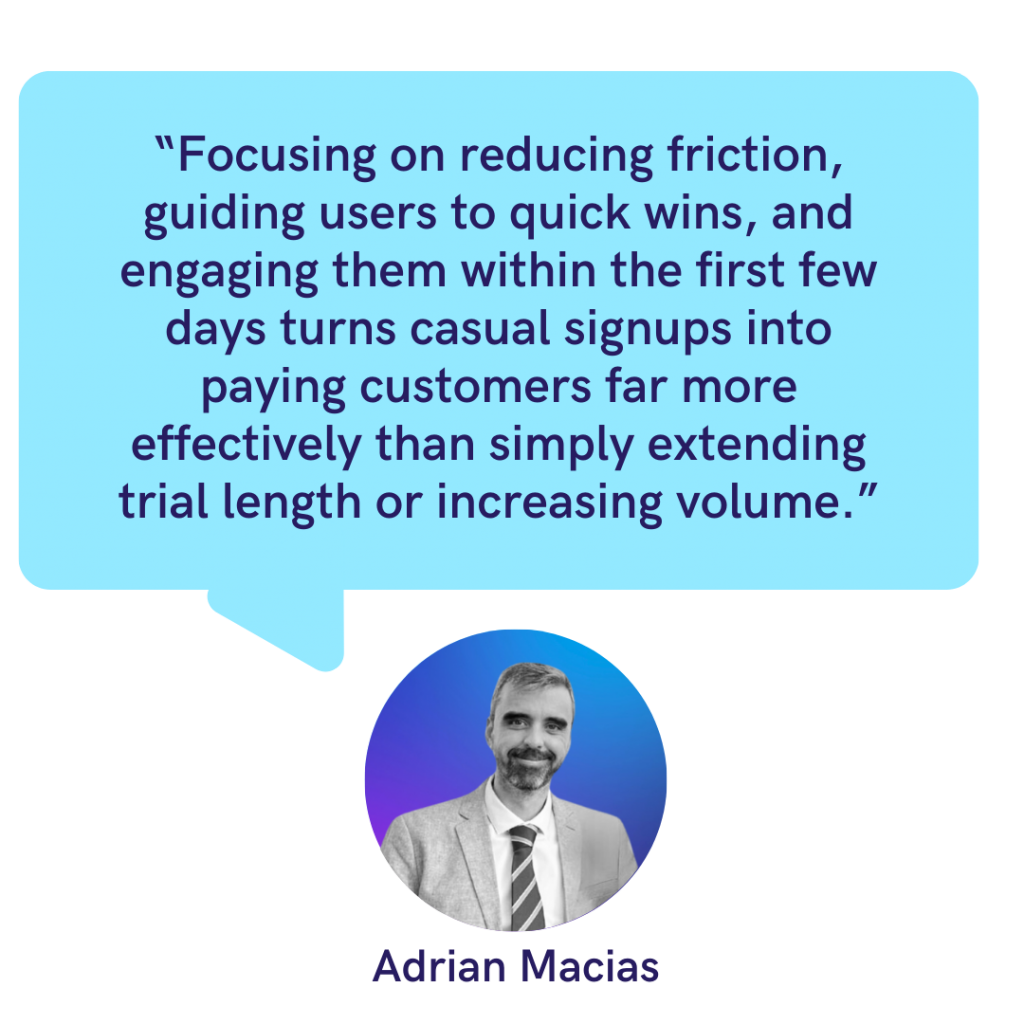
Trial activation rate measures what percentage of trial signups actually begin using your product, login, complete initial setup, take first meaningful action. Surprisingly, many trials show 30-50% of signups never activate at all, they register but never return to actually evaluate the product. This suggests signup came from casual interest rather than genuine evaluation intent, or that friction between signup and first usage prevents follow-through. Improving trial activation focuses on reducing friction between signup and usage. Immediate access without waiting for verification emails increases activation. Clear next-step guidance in signup confirmation emails or pages prevents users from losing momentum. Proactive outreach within 24 hours of signup reminds users to begin evaluation before interest fades. Progressive onboarding that guides users to quick wins in first session prevents overwhelm from complex products.
Time-to-first-value measures how long trial users take from signup to experiencing core product value, completing their first workflow, achieving their first outcome, or experiencing the capability that solves their problem. Shorter time-to-first-value typically predicts higher trial-to-paid conversion because users who quickly experience value are more likely to complete evaluation and decide your product meets their needs. Products with complex setup requirements or steep learning curves often show time-to-first-value measured in days or weeks, creating challenges for 7 or 14-day trial periods. Users spend their trial wrestling with configuration rather than experiencing value, leading to trial expiration before proper evaluation. Addressing this requires either simplifying setup, extending trial periods, providing setup assistance, or redesigning trials to demonstrate value before requiring full setup.
Trial-to-paid conversion rate measures what percentage of trial users convert to paying customers. Industry benchmarks vary enormously, from 10% for complex products with long evaluation cycles to 40% for simple products with obvious value propositions but understanding your baseline enables measuring improvement from optimisation efforts. Conversion rates should be segmented by trial source, user characteristics, and engagement levels. Users who arrived from high-intent channels (comparison sites, peer referrals) typically convert at 2-3 times the rate of those from low-intent channels (broad awareness campaigns). Users who completed onboarding convert at higher rates than those who did not. Users who adopted multiple features convert higher than those who used only basic capabilities. These patterns guide conversion optimisation priorities. If users who complete onboarding convert at 50% whilst those who do not convert at 5%, the highest-leverage improvement is increasing onboarding completion rates rather than trying to convert non-engaged users. If certain trial sources convert at 40% whilst others convert at 8%, shifting acquisition budget toward high-converting sources produces more conversions per acquisition pound spent.
Conversion nudges delivered throughout trial period remind users of trial status, demonstrate additional value, and encourage conversion decisions. Effective nudge strategies include:
Day 1-2: Welcome and quick start guidance ensuring users know how to begin experiencing value Day 3-5: Feature education highlighting capabilities beyond what users have discovered organically Day 7: Trial midpoint reminder with usage stats showing value already received Day 10-12: Conversion encouragement with testimonials, case studies, or limited-time offers Day 13-14: Trial expiration warning with clear conversion path and offer extension if needed. The cadence, channel (email, in-app messaging, push notifications), and content of nudges should be tested through A/B experiments. Some users respond to frequent outreach, others find it annoying. Some respond to feature education, others to social proof or ROI calculations. Segmenting nudge strategies by user characteristics and engagement patterns enables personalising approaches to what works for specific user types.
Trial length optimisation balances two opposing forces. Longer trials provide more evaluation time, potentially allowing users with slow setup or complex use cases to fully evaluate your product. Shorter trials create urgency that motivates rapid evaluation and decision-making rather than indefinite deferral. The optimal length depends on time-to-first-value and evaluation complexity. If users typically experience value within 2-3 days and can meaningfully evaluate fit within a week, 7-day trials might be optimal, long enough for thorough evaluation, short enough to maintain urgency. If setup takes days and meaningful evaluation requires using your product for real projects over weeks, 30-day trials might be necessary to enable proper evaluation. Data on usage patterns throughout trial periods reveals optimal lengths. If most users who will convert have made that decision by day 10 (high usage through day 10, conversion decision happens day 10-14), whilst users showing minimal engagement by day 10 rarely convert regardless of trial length, perhaps 14-day trials are optimal, long enough for motivated users, not so long that unmotivated users create false hope of eventual conversion.
Source-based trial performance reveals which acquisition channels deliver trial users who actually convert. A channel delivering 1,000 trial starts at £5 cost per trial with 12% conversion produces 120 customers at £41.67 each. A channel delivering 300 trials at £15 each with 40% conversion produces 120 customers at £37.50 each, superior economics despite 3x higher cost per trial. This analysis guides acquisition investment toward channels delivering high-conversion trials rather than high-volume trials. The channel with cheaper trials but lower conversion might still be worth maintaining if volume matters for other reasons (brand awareness, market education, viral potential), but channel budget should shift toward higher-conversion sources when the primary objective is efficient customer acquisition.
Onboarding Conversions
Onboarding represents the critical bridge between signup and activation, where users discover whether your product delivers the value that acquisition promised. Effective onboarding doesn’t just teach users how to use your product, it ensures they experience meaningful value before friction, confusion, or competing priorities cause abandonment.
Defining onboarding success requires identifying which actions or outcomes indicate users have experienced sufficient value to become retained customers. This “activation event” might be completing a specific workflow, achieving a measurable outcome, adopting particular features, or reaching usage thresholds. The definition should be based on data showing which early experiences predict long-term retention rather than assumptions about what matters. A typical analytical approach examines retention rates for users who completed various potential activation events within their first week, comparing to baseline retention for all users. If baseline 90-day retention is 40%, but users who completed Workflow X within first week retain at 75%, completing Workflow X is likely your activation event, the experience that predicts users will become retained customers. Once identified, activation becomes your North Star metric for onboarding, the outcome you optimise the entire onboarding experience to deliver. Everything in onboarding should guide users toward experiencing that activation event as quickly and with as little friction as possible.
Activation rate measures what percentage of signups complete your defined activation event. If 1,000 users sign up and 400 complete the activation event, your activation rate is 40%. This becomes your primary onboarding metric, more important than signup volume because activated users are the only ones with meaningful retention and lifetime value potential. Activation rates vary by product complexity and value proposition clarity. Simple productivity tools with obvious value might achieve 70-80% activation. Complex enterprise platforms requiring substantial configuration might achieve only 30-40%. The key is establishing your baseline, understanding factors that predict activation likelihood, and systematically improving the rate through onboarding refinements.
Time to first key action measures how long users take from signup to completing critical early actions that predict activation. If users who complete Setup Action A within 24 hours activate at 70% whilst those taking longer activate at 30%, reducing time-to-completion of Action A becomes a key optimisation target. This metric reveals onboarding friction points. If median time-to-first-action is 3 days but activated users typically complete it in 4 hours, most users are experiencing unnecessary delay, perhaps unclear instructions, missing dependencies, or competing priorities. Reducing this delay through clearer guidance, automated setup, or proactive assistance improves activation by moving more users toward activated-user timeframes.
Feature adoption tracks which product capabilities users discover and adopt during onboarding. Not all features are equally important for activation, but typically 2-4 core capabilities must be discovered and used for users to experience sufficient value. Tracking adoption of these core features reveals where onboarding fails to guide users toward value-creating experiences. A common pattern is that users engage with immediately obvious features but never discover more powerful capabilities that require explanation or guidance to understand. They experience modest value from surface-level usage but never reach the transformational use cases that create genuine stickiness. Effective onboarding systematically guides users to these high-value features rather than assuming they’ll discover them organically.
Onboarding completion rate measures what percentage of users complete defined onboarding flows; perhaps a series of tutorial steps, setup tasks, or guided actions. If only 30% complete your onboarding flow, 70% are abandoning before experiencing guided value demonstration, dramatically reducing activation likelihood. Low completion rates indicate onboarding is too long, too complex, or not sufficiently engaging. Users either do not understand why completing onboarding matters (insufficient value communication), find it tedious (too many steps for perceived benefit), or get distracted and never return (lost momentum). Improvements focus on shortening flows, making them more engaging through gamification or visual feedback, or demonstrating value throughout rather than only at completion.
Best practices in onboarding design from high-performing subscription businesses include:
Progressive disclosure introduces complexity gradually rather than overwhelming users with full product capabilities immediately. First session focuses on single core workflow demonstrating clear value. Subsequent sessions introduce additional capabilities building on established foundation. This prevents cognitive overload whilst ensuring users experience value before encountering complexity.
Contextual guidance provides help at the moment users need it rather than upfront tutorials they must remember. Tooltips appear when users encounter new features. Tutorials trigger when users attempt actions requiring explanation. This just-in-time approach is more effective than requiring users to complete comprehensive tutorials before they can use your product.
Gamification elements provide motivation and progress feedback that encourages completion. Progress bars show onboarding advancement. Completion celebrations provide positive reinforcement. Achievement unlocks create satisfaction from completing milestones. These psychological mechanisms leverage game design principles to increase completion rates.
Personalised onboarding adapts to user characteristics, role, or stated use case. Enterprise users see different onboarding emphasising team features and advanced capabilities. Solo users see simplified onboarding focusing on individual productivity. This personalisation ensures users experience onboarding relevant to their needs rather than generic flows addressing all use cases mediocrely.
Time-based reminders re-engage users who abandon onboarding before completion. Email or push notifications within 24-48 hours remind users to continue, perhaps highlighting specific value propositions or offering assistance. Multiple touchpoints over first week prevent permanent abandonment from temporary distraction.
Human assistance availability for users struggling with onboarding dramatically improves activation among high-value prospects. Live chat support, onboarding specialists who proactively reach out, or scheduled onboarding calls ensure confused or stuck users receive help rather than abandoning. The cost of human assistance is easily justified by improved activation among users with high lifetime value potential.
Conclusion
In subscription businesses, acquisition alone is not enough. High signup numbers are meaningless if the majority of users never experience the product’s core value. Activation, the moment a user experiences meaningful value, drives retention, lifetime value, and the compounding economics that make subscription models sustainable. Companies that treat activation as an afterthought often pay the price through high churn, wasted acquisition spend, and distorted analytics that obscure the true health of the business.
Investing in activation pays dividends across the customer lifecycle. From well-designed free trials that reduce friction and demonstrate value quickly, to onboarding flows that guide users toward their first meaningful outcomes, each improvement directly boosts the proportion of users who become retained customers.
Subscription businesses that master this balance; delivering value immediately, guiding users through effective onboarding, and optimising trial experiences, create a self-reinforcing loop of engagement, retention, and sustainable growth. Activation is not just a step in the funnel; it is the foundation upon which every successful subscription business is built.
Get In Touch
Our friendly team are always on hand to answer questions, troubleshoot problems and point you in the right direction.