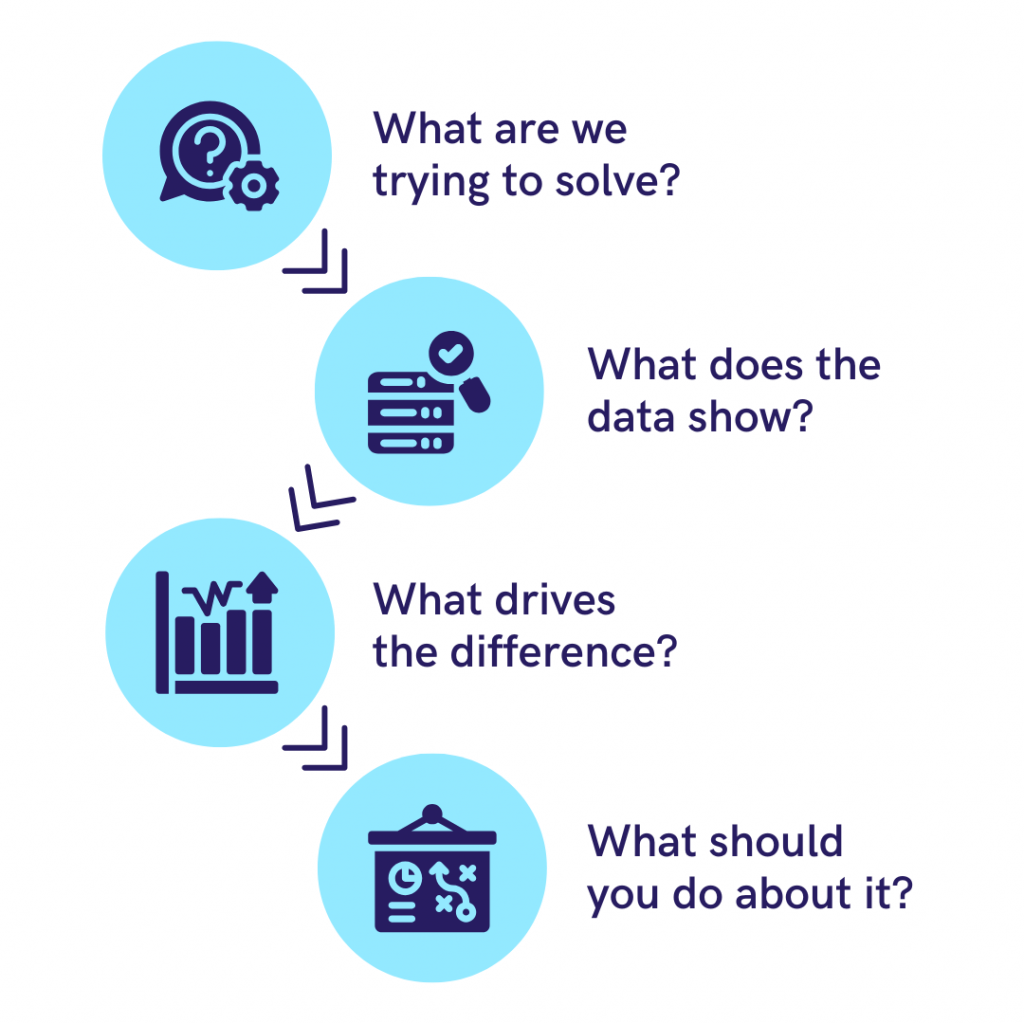
Identify the specific behaviours that separate high-adoption facilities from those that plateau or churn.
Obstacle
Only 1 in 5 facilities was hitting the adoption target, with no data-driven understanding of why.
Outcome
A prioritised plan outlining the specific thresholds, triggers, & interventions to systematically improve adoption.
Background
voize is an AI-powered documentation tool for care facilities, designed to reduce the administrative burden on nurses by capturing clinical documentation through voice. voize was onboarding facilities at a healthy rate, but overall adoption wasn’t growing proportionally. Some facilities achieved strong, sustained usage within weeks. Others plateaued or declined quietly, and no one could explain the difference with confidence. voize turned to 173tech to do a deep-dive analysis to try and understand why.
Challenges
Inconsistent Tracking: The immediate challenge was that failure looked different in each case: some facilities never got started properly, others showed early promise and then stalled, and without a consistent framework for what good looked like in week one, the customer success team had no reliable trigger for when to intervene or what to do when they did.
Mass Data: With more than five years of data spread across PostHog, InfluxDB, and Google Sheets, voize knew the answers were buried somewhere across 108 facilities and thousands of users, but extracting consistent, comparable signals from such a fragmented dataset was the real analytical challenge.
Solution
First Week Signals: The analysis identified a set of week-one thresholds that each independently associated with dramatically higher long-term success rates, and together created a combined indicator with real predictive power. We identified three conditions, which, when met simultaneously, saw the success rate jump to 65%, compared to just 10% for facilities missing any one of them. The data made clear that the first week wasn’t just important: it was where the trajectory of the next six months was effectively being set.
Proactive Intervention: Rather than identifying struggling facilities weeks after they had already drifted off track, the combined indicator gives the CS team a reliable signal by day three or five of onboarding, early enough to intervene before patterns become entrenched. We created a week-one activation checklist which translated our findings directly into a scoring tool the team can use on every new facility, with clear escalation rules.
Impact
Prioritised Action Plan: Beyond the activation framework, the analysis surfaced clear trends across training method, product usage, and facility size, giving voize an evidence base to prioritise where onboarding investment will have the greatest effect.
An onboarding process grounded in outcomes: Training scripts, activation checklists, and launch criteria can now be designed around the behaviours that actually predict six-month success rather than intuition or convention.
A foundation for ongoing experimentation: With baselines established and key variables identified, voize can now design controlled tests to move from correlation to causation and measure the impact of onboarding changes with confidence.
Creating Value For voize...
We analysed behavioural data across108 facilities,
Identified 3 conditions that predict a65% adoptionsuccess rate,
And delivered a prioritised plan that gives voize's customer success team a reproducible system for onboarding success.