
Data clean rooms have become essential infrastructure for businesses trying to understand the true sales impact of their partnerships, marketing channels, or service providers, without compromising customer privacy. Here’s some important factors to consider when setting one up.
Introduction
In practice, a data clean room is a secure environment where two parties can analyse the overlap and interaction between their datasets without either party seeing the other’s raw data.
Think of it like this: you have customer sales data, your provider has engagement data, and you both want to know if their work drives your revenue. Instead of emailing spreadsheets back and forth (a GDPR nightmare), you both send anonymised data to a neutral environment. The clean room allows approved queries that return aggregated insights “customers who engaged with the provider converted 23% better” but prevents anyone from extracting individual customer records.
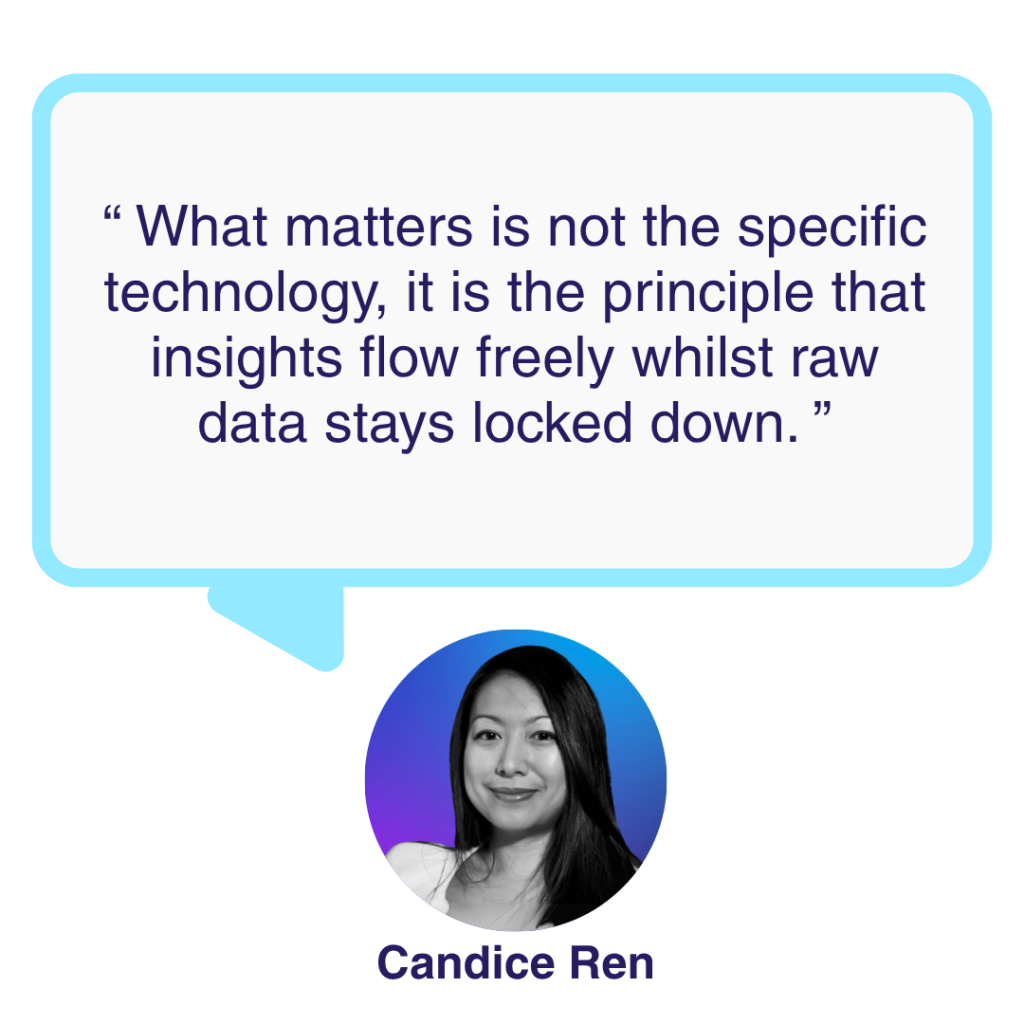
The technical implementation might be a dedicated cloud environment (AWS Clean Rooms, Google Ads Data Hub), a specialist platform (Snowflake Data Clean Room, InfoSum), or even a carefully configured database with strict access controls. What matters isn’t the specific technology, it’s the principle that insights flow freely whilst raw data stays locked down.
1. Start with the business question
The worst clean room implementations begin with “we need a data clean room” and end with an expensive piece of kit that nobody uses.
Before you write a single line of SQL or speak to any vendors, get crystal clear on what you are trying to measure. For provider impact analysis, that usually means defining what “sales impact” actually means in your business. Is it first-touch attribution? Last-touch? Multi-touch? Are you measuring immediate conversions or longer-term customer value?
Your measurement framework needs to exist before your clean room does. The technology should serve the question, not create it.

2. Establish data minimisation principles
Clean rooms exist because neither party wants to hand over their crown jewels. Your provider doesn’t want to give you their customer list, and you don’t want to expose your entire sales database to them.
Work out the absolute minimum data required to answer your business question. If you’re measuring whether a healthcare provider’s referrals are converting to sales, you likely need anonymised patient identifiers, referral dates, and conversion events, not full medical histories or detailed customer profiles.
The GDPR principles of data minimisation and purpose limitation are not just legal requirements; they’re practical constraints that force you to think clearly about what you actually need. Embrace them.
Expert help is only a call away. We are always happy to give advice, offer an impartial opinion and put you on the right track. Book a call with a member of our friendly team today.
3. Define your matching strategy before you build anything
The hardest technical part of most clean room projects is not spinning up the platform or locking down access, it is entity resolution: reliably matching “the same person” across two organisations without exchanging PII. If you cannot link records well, your measurement collapses into either tiny samples (low match rate) or misleading results (bad matches), no matter how polished the clean room infrastructure is.
In practice, teams usually start with deterministic identifiers like hashed emails or phone numbers, because they are straightforward and auditable, if both sides have the identifier and format it the same way.
When that is not available or coverage is patchy, you might use probabilistic matching on demographics/attributes (broader reach, but introduces uncertainty and false matches), or rely on third-party identity graphs (better coverage, but adds cost, dependency, and a more complex privacy story). For digital channels, browser/device identifiers can work, but they are increasingly constrained by consent and platform changes.
Each method is a trade-off between match rate, accuracy, and privacy. Hashed emails might only get you something like 60–70% on a good day, probabilistic approaches can inflate coverage but reduce confidence, and identity graphs can boost linkage at the expense of external dependency. The practical move is to test the matching strategy on a representative sample first, if you cannot reach a match rate and quality that makes the business question answerable, it is a warning sign to change approach (or stop) before you invest in the full build.

4. Build for incrementality not correlation
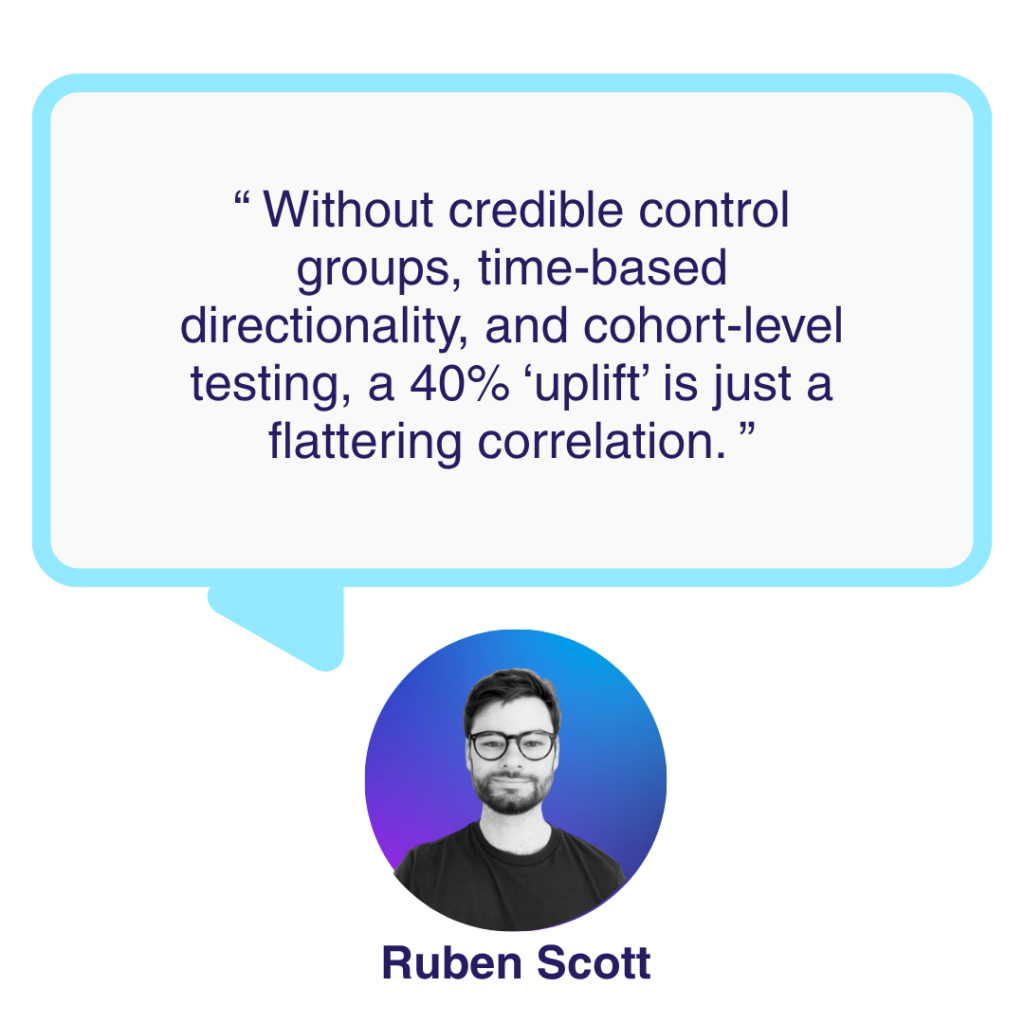
It’s easy for a provider to walk in with a slick dashboard showing that customers who used their service spend 40% more with you. The trap is that this might be selection, not impact: the customers who engage with that provider could already be your highest-value, most engaged segment, so the “uplift” is just describing who they are, not what the provider caused.
That’s why your clean room has to enable incrementality, not just correlation. At a minimum, you need credible control groups: customers who did not use the provider but look similar on the characteristics that predict spend (prior spend, tenure, product mix, geography, channel, seasonality). If you cannot create a comparable control, you can’t separate “they’re great customers” from “the provider made them better.”
You also need time-based analysis to establish directionality: did behaviour change after provider engagement, and by how much compared to the control? Techniques like pre/post with a matched control, difference-in-differences, and clearly defined “exposure” and “outcome” windows help stop you attributing existing momentum to the provider.
Finally, make cohorts a first-class feature: new customers vs existing, high-frequency vs low-frequency, and different acquisition channels often behave very differently. The clean room should make it easy to run these segmented tests and produce interpretable outputs (lift, confidence intervals, robustness checks), rather than vanity metrics that simply confirm everyone’s preferred story.
















































5. Agree on governance & access controls upfront
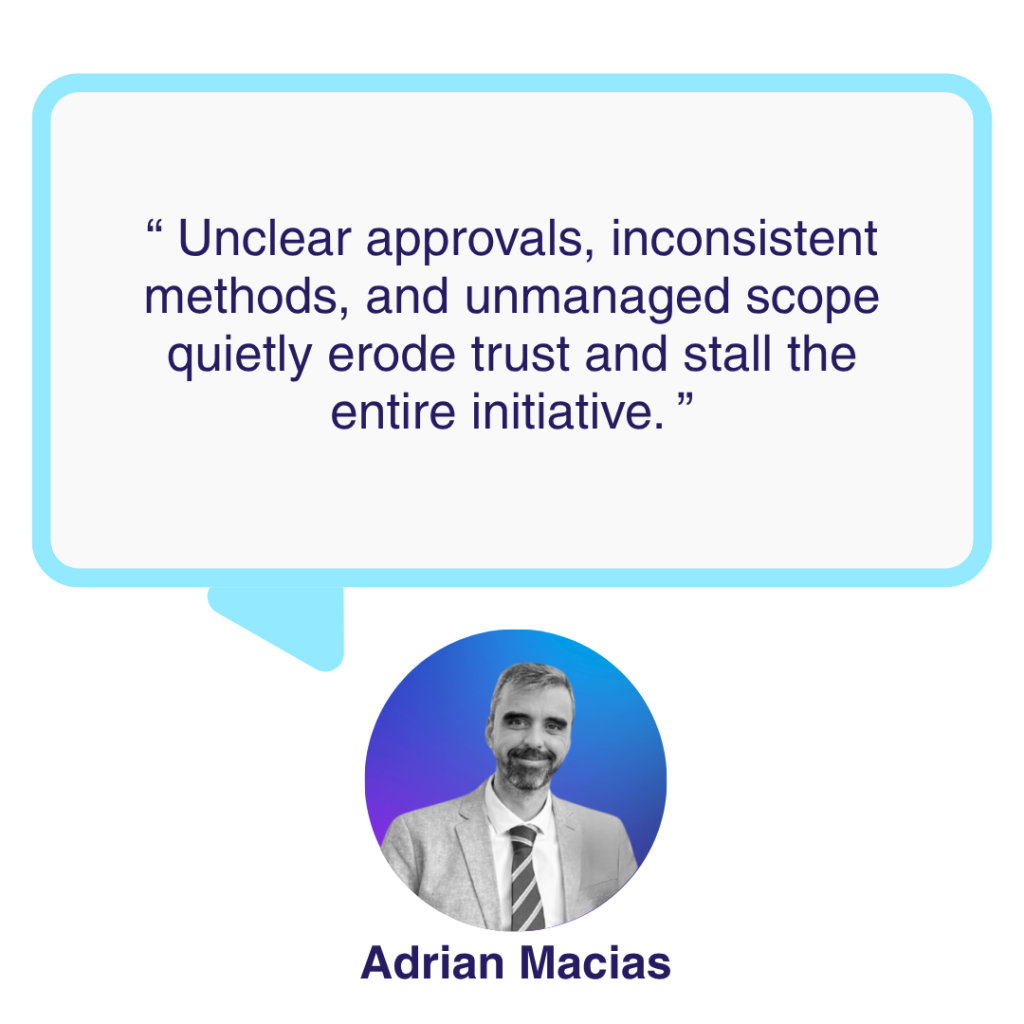
Governance is the part that quietly decides whether your clean room succeeds or dies. It is not the SQL or the cloud setup that derails most projects, it is unanswered questions like: who’s allowed to run queries, who signs off new requests, what happens when someone asks for an analysis that was not in scope, and how you safely onboard new data sources without turning every change into a legal and security fire drill.
You need an operating model that makes these decisions routine. That usually means a query approval workflow (what is pre-approved vs what needs review, who the reviewers are, and turnaround expectations), plus a result validation process so outputs are consistent and defensible (standard methodologies, minimum cell sizes, suppression rules, and reproducible runs). Without this, you will get “one-off” analyses that cannot be repeated and results that different people interpret, or challenge, depending on what they want to be true.
You also need a plan for conflict: dispute resolution when the provider disagrees with your interpretation, when match rates are questioned, or when someone claims the clean room is being used to reverse-engineer insights. Add practical scheduling and accountability on top: data refresh cadence (what updates when, and how changes are communicated), and audit requirements (logging who ran what, what data was used, and what was exported/aggregated). Write this down before you build; retrofitting governance after people have access and expectations is where projects bog down and trust erodes fast.
Conclusion
From an impartial data agency’s perspective, clean rooms are less about novel privacy technology and more about bringing accountability to partner measurement. When designed properly, they separate real incremental impact from selection effects,so you can see whether a provider is genuinely driving outcomes or simply associating themselves with customers who would have converted anyway.
That clarity improves decision-making across the partnership lifecycle: where to invest more, which relationships to scale, and which to renegotiate or exit. In most cases the core tooling is mature; the differentiator is the discipline to frame the right hypotheses, run credible incrementality tests, and accept what the data says,even when it challenges the narrative.
