Two-sided marketplaces are not just buying and selling platforms, they include dating apps (connecting singles), job boards (connecting candidates and employers), dog-sharing platforms, salon booking tools, and any business where value is only created when two distinct groups successfully connect.
Introduction
Most analytics frameworks were built for businesses with one type of customer. You acquire them, onboard them, retain them. The funnel is linear, the metrics are consistent, and the reporting is fairly straightforward.
Two-sided marketplaces are a different beast entirely. You have two distinct customer types: supply and demand and your business only works if both sides are healthy simultaneously. Track only one side and you’re flying blind. Track both without a clear framework and you end up with dashboards that look comprehensive but can’t answer the questions that actually matter.
This article walks through what good tracking looks like for a standard business, where it breaks down for marketplaces, and what to actually do about it.
Acquisition
For a single-sided business: Acquisition tracking is fundamentally about answering one question: which channels are bringing in the customers who are worth having? You connect your paid platforms: Google, Meta, LinkedIn, to your CRM and your payment data, define a consistent CAC, and start optimising. The goal is to find the channels that deliver customers with the highest LTV at the lowest cost.
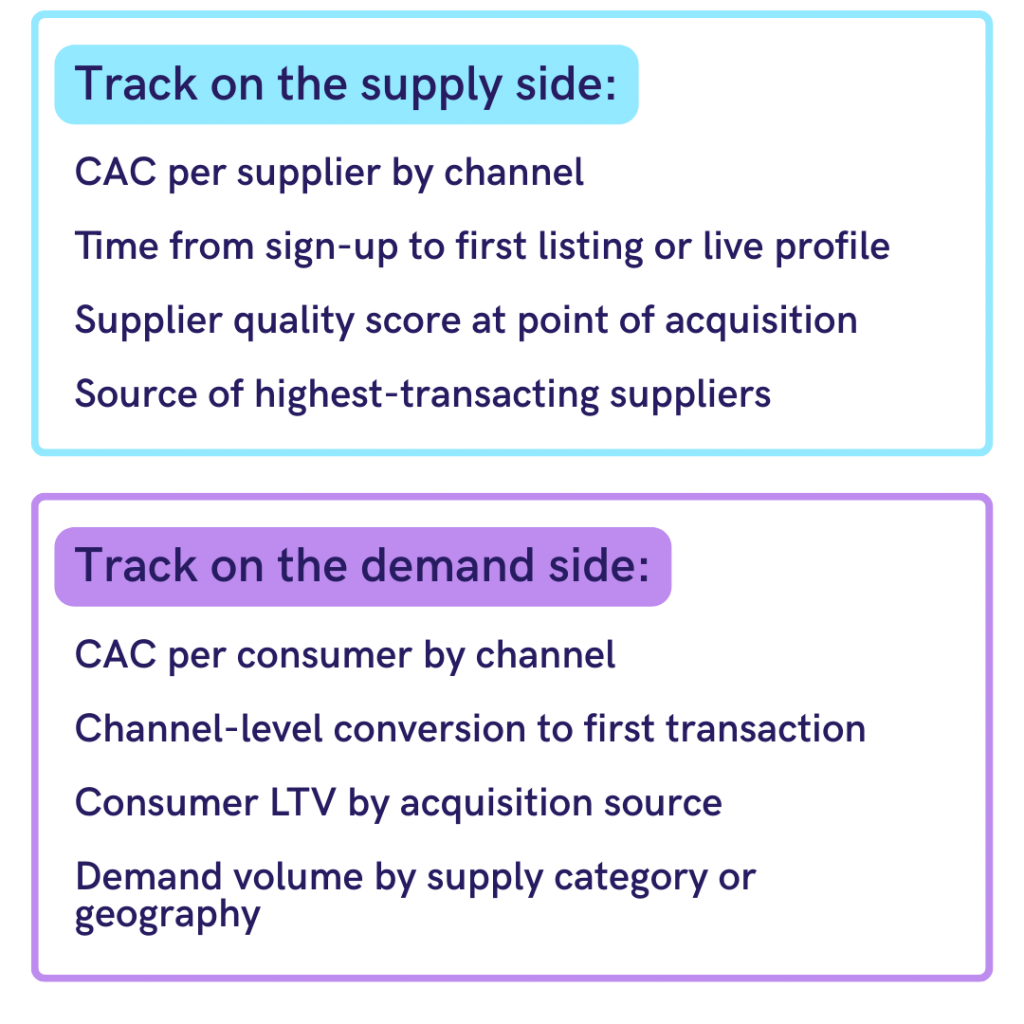
For a two-sided marketplace: You are running two acquisition programmes at once, but they are not independent. The value you can offer each side depends on the health of the other, which means your CAC calculations are more complex than they appear, and optimising one side in isolation can actively damage the other.
The core questions become:
Are you acquiring supply and demand in the right ratio for your marketplace to function? Too much demand and no supply creates a poor consumer experience. Too much supply and no demand demoralises your suppliers and drives churn.
Which demand-side acquisition channels produce consumers who actually transact with your suppliers or do some channels produce browsers who never convert?
Which supply-side acquisition channels bring in the sellers, hosts, or providers who generate the highest consumer satisfaction and repeat demand?
Activation
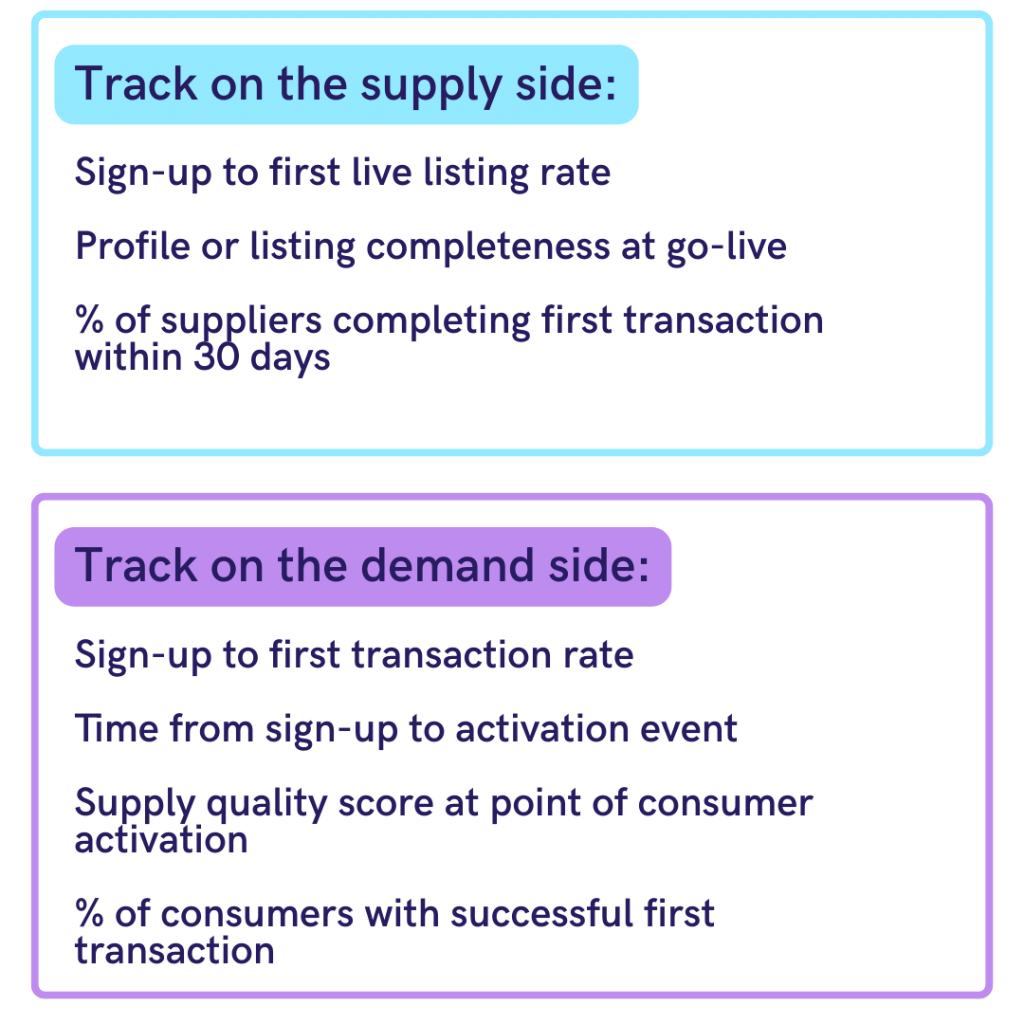
For a single-sided business: Activation is the moment a new user first experiences meaningful value, the ‘aha moment’ that makes them likely to return. For a SaaS product it might be completing onboarding and running a first workflow. For a D2C brand it’s receiving and being satisfied with a first order. Defining this moment precisely and tracking it as a named event is one of the highest-value things a data team can do. The key question: what percentage of sign-ups reach the activation event, and how quickly? This single metric often unlocks more growth than any amount of top-of-funnel spend.
For a two-sided marketplace: Activation needs to be defined separately for each side, and the two definitions are different in character. Supply-side activation is usually operational: a supplier has their profile or listing in a state where transactions are possible. Demand-side activation is experiential: a consumer has completed a transaction and had a good outcome. The harder problem is that demand-side activation is often dependent on supply-side quality. A consumer who signs up and immediately encounters sparse listings, a slow supplier response, or a failed transaction will churn before they ever reach their activation moment. You need data that connects the quality of supply at the point of demand activation.
Expert help is only a call away. We are always happy to give advice, offer an impartial opinion and put you on the right track. Book a call with a member of our friendly team today.
Retention
For a single-sided business: Retention is where most of the long-term value in a business is won or lost. Acquiring a customer is expensive; keeping them is relatively cheap once the product is working. The goal is to understand which behaviours predict long-term retention and to intervene early when users show signs of disengagement. Cohort analysis is the standard tool: group users by acquisition month, track their engagement over time, and identify the patterns that separate retained users from churned ones.
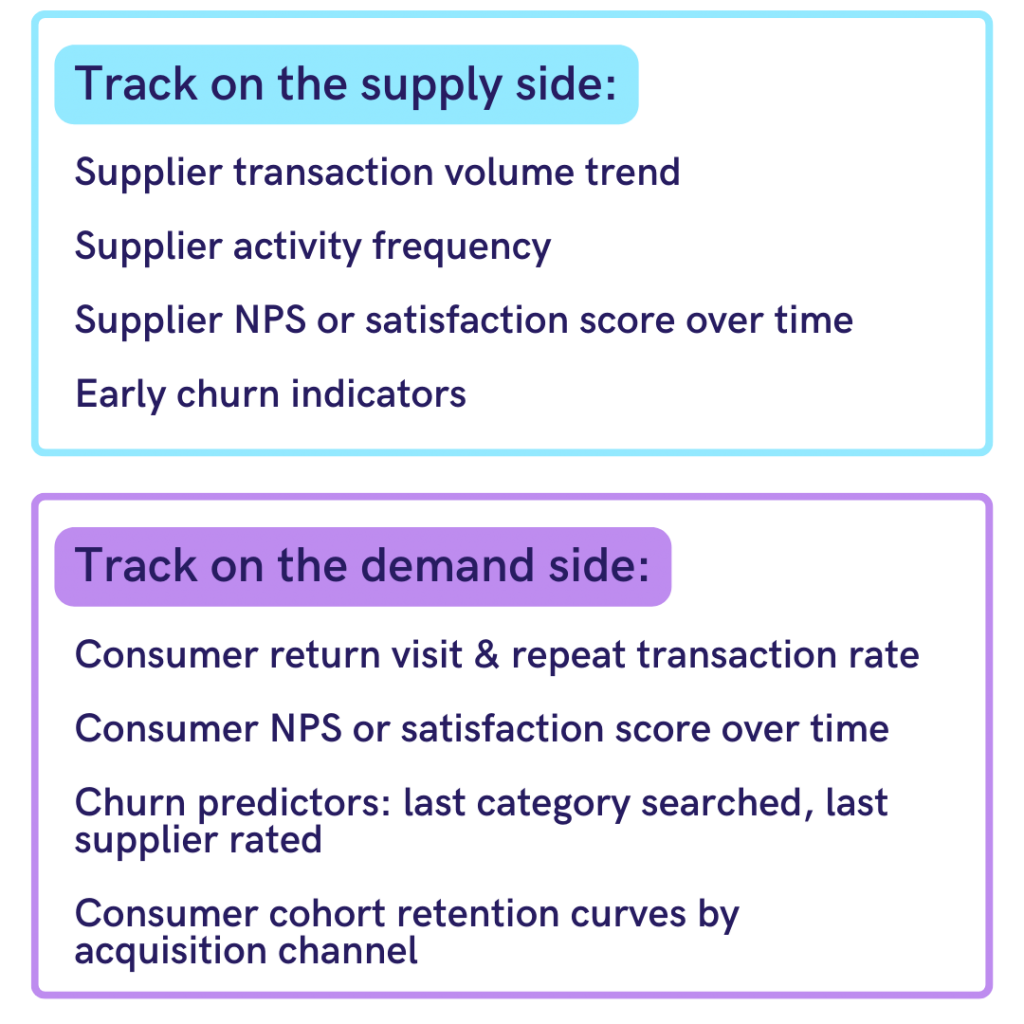
For a two-sided marketplace: Retention on a marketplace is a mutual dependency. Consumers return because supply is good. Suppliers stay because demand is consistent. Each side’s retention is partly a function of the other’s health, which means supplier churn and consumer churn can trigger each other in a feedback loop that is easy to miss until it becomes a serious problem. Running cohort analysis on each side independently is not enough. You need to compare them on the same timeline and look for the leading indicators that predict cross-side deterioration before it becomes visible in your headline numbers.
Revenue
For a single-sided business: Revenue analytics for a single-sided business is about understanding the quality of your revenue, not just the quantity. What is the LTV of each cohort? What is your net revenue retention? Which customer segments are most profitable, and are you acquiring more of them or fewer? For subscription businesses, MRR decomposition: breaking monthly revenue into new, expansion, contraction, and churn components, gives you the clearest picture of whether the business is genuinely improving or just masking churn with new acquisition
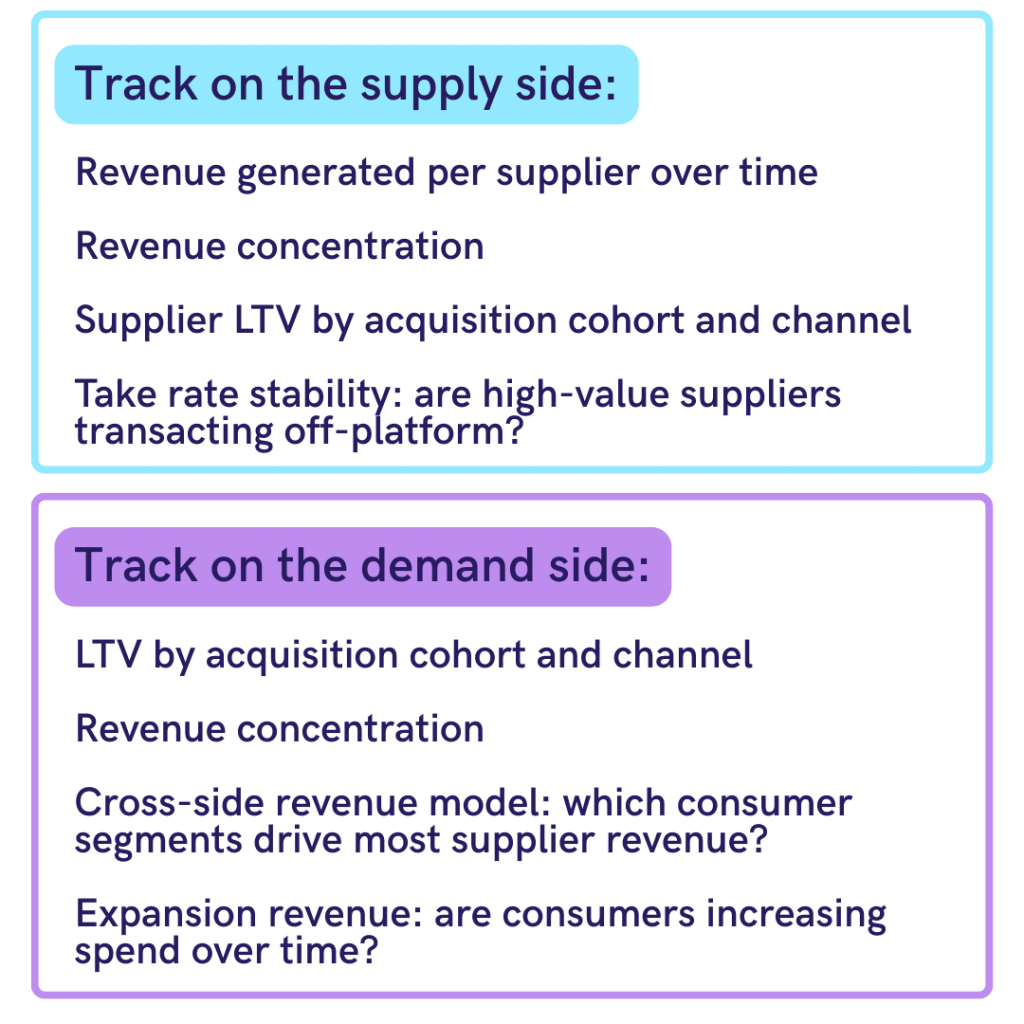
For a two-sided marketplace: Revenue on a marketplace flows from transactions between two parties, which means your revenue analytics need to track what is happening on both sides of every deal. GMV (gross merchandise value) is the standard top-line metric, but it can be deeply misleading without the context underneath it. A handful of high-volume suppliers can inflate GMV whilst the majority of your supply base generates very little. Consumer spend can look healthy in aggregate whilst cohort-level retention is deteriorating. Revenue concentration is a risk on both sides, and you need to be measuring it on both.











































The common thread
At every stage of the funnel, the duality of a two-sided marketplace introduces the same fundamental challenge: the metric you are looking at is a cross-side outcome, but your data infrastructure is almost certainly organised by side. Acquisition data lives with the team that runs acquisition. Supplier data lives with the team that manages supply. The cross-side models that connect them (and that answer the questions that actually matter) do not exist unless someone has deliberately built them.
The solution is not complicated. You need a single warehouse where both sides’ data lives. You need consistent identifiers so every transaction links to both a supplier and a consumer. You need a modelling layer that defines your metrics once and makes them queryable from either direction. And you need someone who owns the cross-side questions, not just the performance of each side independently.
The marketplaces that build this infrastructure early gain a compounding advantage: every growth decision is grounded in a complete picture of what is happening, rather than half of it.