
Tracking Online Visitors
Understanding how customers find you, what they do on your platform, and why they convert, has become increasingly complex. For businesses, where customer lifetime value and retention metrics drive strategic decisions, precise tracking is not merely helpful; it is essential.
Yet today’s businesses face a paradox. Whilst the need for accurate data has never been greater, but the ability to collect that data has never been more constrained. Cookie consent requirements, privacy regulations, and evolving browser technologies have collectively undermined the tracking methods that businesses have relied upon for years. So how should you tackle these challenges?
Privacy Regulations & Cookie Consent
The transformation of digital tracking began in earnest with the European Union’s General Data Protection Regulation in 2018, followed by California’s Consumer Privacy Act and similar legislation across numerous jurisdictions. These regulations established a fundamental principle: businesses must obtain explicit consent before collecting personal data through tracking technologies like cookies.
Regulations require clear consent mechanisms, detailed privacy policies, and user-friendly options for withdrawing consent. Whilst these protections serve important purposes for consumer privacy, they have created significant challenges for businesses attempting to understand their customers’ journeys.
The consent requirement alone has transformed the tracking landscape. Companies can no longer assume universal data collection across their user base. Instead, they must design systems that function gracefully when users decline tracking consent, whilst still maintaining visibility into business performance. This shift has exposed the fragility of tracking infrastructure that many businesses built without considering scenarios where large proportions of users would opt out.
Beyond explicit regulations, broader cultural shifts towards privacy awareness have accelerated these challenges. Users increasingly want to understand how their data is collected and used, and many actively take steps to limit tracking. This awareness, combined with regulatory requirements, has created an environment where businesses must fundamentally rethink their approach to measurement.


Understanding Today's Reality
Multiple forces have converged to create an environment where pixel-based tracking, the cornerstone of digital analytics for years, has become increasingly unreliable.
Consider the user behaviour that businesses now face regularly. When presented with cookie consent banners, the majority of users either reject all but essential cookies or simply abandon the site entirely rather than engage with consent mechanisms. Research consistently demonstrates that only a small minority of users actively accept all tracking cookies when given granular consent options. This creates a fundamentally skewed understanding of user behaviour.
Browser manufacturers have accelerated this trend through built-in privacy features. Apple’s Intelligent Tracking Prevention, Mozilla’s Enhanced Tracking Protection, and similar features in other browsers actively block third-party cookies and limit first-party cookie lifespans. These protections operate regardless of user cookie preferences, creating an additional layer of tracking prevention that businesses cannot overcome through consent mechanisms alone.
The proliferation of ad blockers are yet another barrier. Many users actively install tools specifically designed to prevent tracking, block analytics scripts, or obscure their digital footprints. These tools have become increasingly sophisticated, moving beyond simple script blocking to actively interfering with analytics implementations in ways that can corrupt data rather than simply preventing collection.
The cumulative effect of these factors is devastating for traditional tracking approaches. The gap between what businesses can observe through pixel-based tracking and what actually occurs has widened to the point where many traditional analytics implementations provide more misleading information than genuine insight.
For subscription businesses specifically, these limitations create particular challenges. Understanding customer acquisition costs requires accurate attribution across the full customer journey. Optimising free trial conversion rates demands visibility into user behaviour patterns. Reducing churn necessitates identifying early warning signals in product usage. When tracking only captures a biased subset of users (typically those least concerned about privacy) all of these critical analyses become fundamentally compromised.
Expert help is only a call away. We are always happy to give advice, offer an impartial opinion and put you on the right track. Book a call with a member of our friendly team today.
Do You Actually Need Perfect Tracking?
Before implementing complex tracking solutions, pause and consider a pragmatic question: how much top-of-funnel tracking do you genuinely need? The tracking challenges described above primarily affect anonymous visitor behaviour, the period before users identify themselves to your business. For many companies, this represents a relatively small portion of the customer journey that matters most.
Once users create accounts, sign up for trials, or begin subscriptions, you gain access to far richer and more reliable data through your own systems. At this point, you know precisely who they are, what features they use, how frequently they engage, and whether they derive value from your service. This authenticated user data remains completely unaffected by cookie consent, browser privacy features, or ad blockers.
Many businesses have discovered that obsessing over perfect attribution for every anonymous visitor actually distracts from more valuable analytical work. If your trial conversion rate stands at 15%, improving your understanding of the 85% who visit your website but never sign up provides marginal value compared to understanding why trialling users do or do not convert to paid subscriptions. The latter question involves users you can identify, track comprehensively, and analyse deeply using your own data.
Rather than investing enormous resources attempting to achieve 100% visibility into anonymous visitor behaviour, an increasingly impossible goal, focus on building robust measurement systems that activate the moment users identify themselves. For authenticated users, tracking becomes dramatically simpler and more reliable. When someone logs into your application/site, you can associate all subsequent activity with their account record. Feature usage flows through your application backend. Subscription changes process through your payment systems. Support interactions appear in your customer service platform. Email engagement connects through campaign identifiers. Every touchpoint generates data that you control completely, creating far richer intelligence than cookie-based tracking could ever provide. For some businesses, this may mean creating a valuable reason why users should log in rather than just browse your site and require additional infrastructure but, if you can find a compelling reason the juice may be worth the squeeze.
This authenticated tracking also enables far more valuable analyses. Instead of merely knowing that someone visited your pricing page three times, you can understand that a specific customer segment struggles to find value in particular features, that users from certain acquisition channels exhibit different retention patterns, or that specific onboarding experiences drive substantially different long-term outcomes. These insights drive meaningful business improvements, whilst perfect attribution of anonymous website traffic often leads nowhere actionable.


Server-Side Tracking
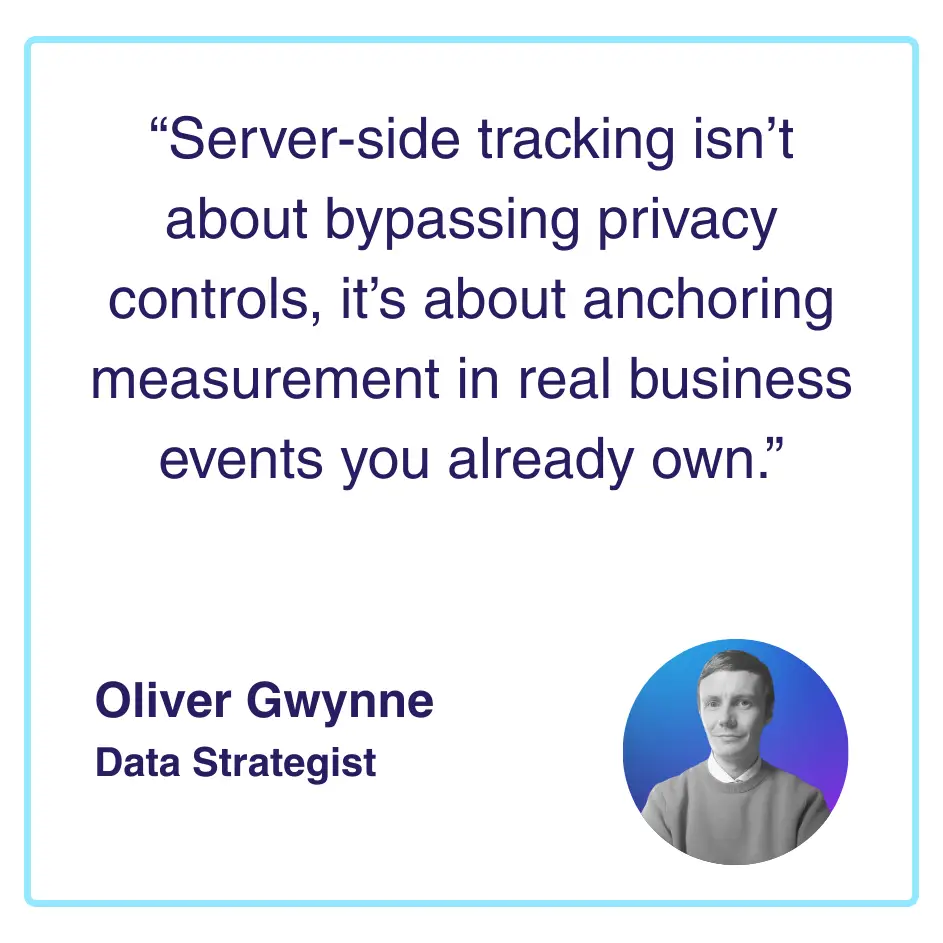
Unlike client-side tracking, which depends on JavaScript executing in user browsers and remains vulnerable to blockers and consent limitations, server-side tracking captures events directly from your own infrastructure. Server-side tracking offers several compelling advantages. When a user completes a purchase, upgrades their subscription, or cancels their account, your backend systems process these events as part of normal business operations. Server-side tracking simply ensures that these business events also flow to your analytics and marketing platforms, creating a complete record of customer behaviour regardless of browser settings or cookie consent.
The implementation approach typically involves capturing events at critical points in your business logic. When you process a new signup, the same code that creates the customer record also sends an event to your analytics platform. When your payment processor handles an upgrade, that transaction triggers both the business logic to update the subscription and the tracking logic to record the event. This tight integration between business operations and tracking ensures that measurement remains accurate even as client-side tracking becomes increasingly unreliable.
Attribution becomes significantly more reliable with server-side tracking. Rather than depending on cookies that may expire or be blocked, you can link user behaviour directly to customer records in your database. When a user who clicked a marketing email three weeks ago finally converts to a paid subscription, your server-side tracking can accurately attribute that conversion because it has access to your complete customer history. This capability proves particularly valuable for subscription businesses where customer journeys often span weeks or months between initial interest and final purchase decision.
Reporting accuracy improves dramatically as well. When subscription businesses compare their analytics dashboards against actual revenue data, server-side tracking implementations typically show far closer alignment. The data flowing into analytics platforms represents actual business events rather than a subset of events that managed to evade blocking, creating far more reliable foundations for decision making.
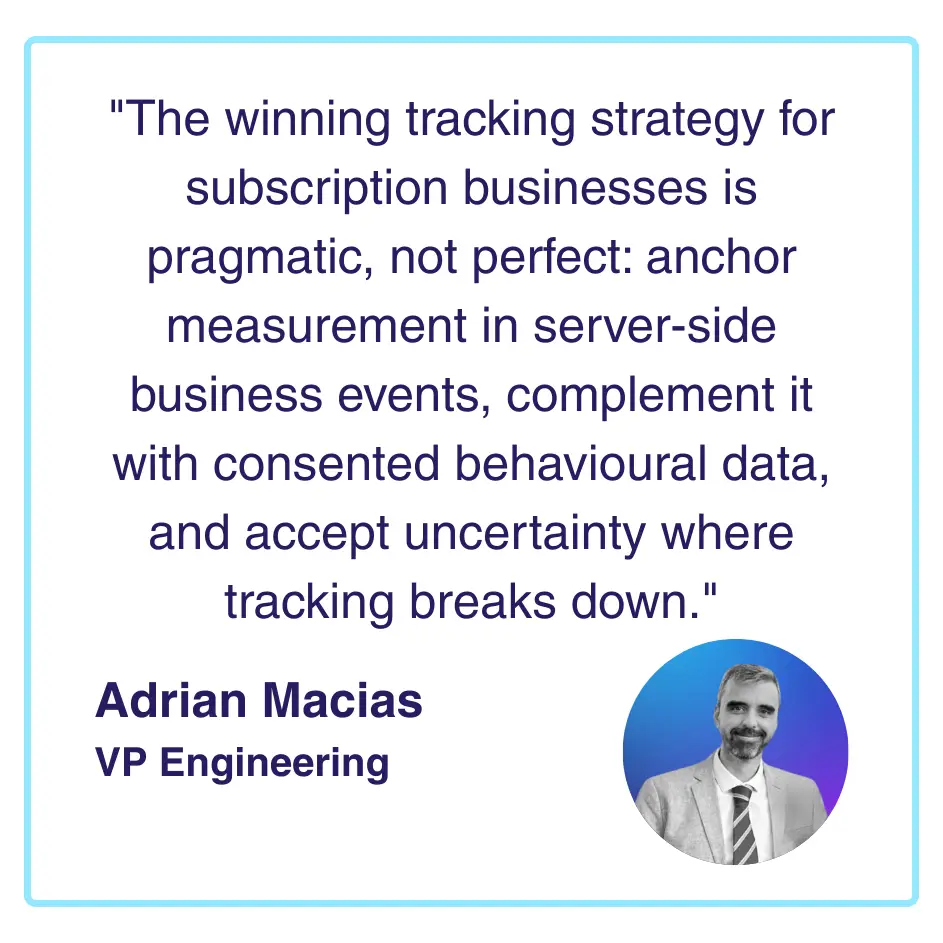
However, server-side tracking does not entirely eliminate the need for client-side measurement. Understanding user behaviour on your website; which pages they visit, how they navigate, where they encounter friction, still requires some client-side tracking. The optimal approach combines both methods: server-side tracking for critical business events and conversions, complemented by privacy-respecting client-side tracking for behavioural insights where users have provided consent.

First-Party Data Capture
Beyond improving how you track user behaviour, the most strategic response to modern tracking challenges involves building robust first-party data assets. First-party data collection opportunities should arise naturally throughout the customer lifecycle. Trial signups capture email addresses and basic profile information. Account management interfaces reveal feature preferences and usage patterns. Subscription changes indicate price sensitivity and value perception. Support interactions expose pain points and satisfaction levels. Payment information provides geographical data and spending capacity signals. Each of these touchpoints represents an opportunity to capture information directly, building a comprehensive customer profile that remains available regardless of tracking limitations.The strategic value of this first-party data extends far beyond immediate analytics needs…
Marketing platforms increasingly enable businesses to create custom audiences based on first-party data rather than cookie-based tracking. You can upload customer email lists to advertising platforms, enabling precise targeting of existing customers for retention campaigns or lookalike audience creation for acquisition efforts. This approach proves far more reliable than cookie-based retargeting, which often fails to reach significant portions of your audience.
Product development decisions benefit enormously from first-party data as well. When you capture detailed usage patterns associated with specific customer profiles, you can identify which features drive retention for different customer segments, which workflows cause confusion or abandonment, and which capabilities justify premium pricing. This intelligence enables far more sophisticated product strategy than aggregate analytics could ever provide.
Customer success initiatives become considerably more effective with comprehensive first-party data. Rather than waiting for customers to churn and attempting to understand why through exit surveys, you can identify warning signals early; declining usage patterns, support ticket frequency, feature adoption stalling, and intervene proactively. For subscription businesses where retention economics typically determine long-term success, this predictive capability proves invaluable.
The challenge, of course, lies in incentivising users to share first-party data voluntarily. Heavy-handed approaches that demand excessive information before providing value typically drive users away rather than building data assets. Successful strategies focus on clear value exchange: users receive genuinely useful functionality, personalisation, or benefits in return for information they provide.
Progressive profiling techniques prove particularly effective. Rather than requesting extensive information during initial signup, you can gradually collect additional data points as users engage with your product. After a user has experienced value from your service, they become far more willing to provide additional information that enables better personalisation or unlocks advanced features.
Transparency about data usage significantly increases user willingness to share information. When businesses clearly explain how they use customer data to improve service, personalise experiences, or provide relevant recommendations, users typically respond positively. The key lies in genuinely delivering on these promises rather than simply collecting data without visible benefit to customers.
Practical Recommendations
Implement server-side tracking for all critical business events. Any action that represents meaningful business value (subscription purchases, plan upgrades, cancellations, payment failures) should trigger server-side tracking regardless of client-side tracking status. This ensures that your most important metrics remain accurate even as client-side tracking degrades. The technical implementation typically involves adding tracking calls to your existing business logic, which most development teams can accomplish relatively straightforwardly.
Maintain client-side tracking for behavioural insights where users consent. Understanding how users navigate your website, which features they explore, and where they encounter friction still requires client-side tracking. However, implement this tracking thoughtfully, only collecting data where users have provided explicit consent, and design your analytics to acknowledge that this data represents a subset of users rather than complete coverage. Many businesses find that understanding behaviour patterns from consenting users still provides sufficient insight for optimisation decisions, even if absolute volume metrics remain incomplete.
Build attribution models that acknowledge tracking limitations. Traditional last-click attribution models become increasingly unreliable when client-side tracking only captures partial customer journeys. More sophisticated approaches combine server-side conversion data with partial client-side journey data, first-party customer information, and statistical modelling to create attribution estimates that acknowledge uncertainty rather than claiming false precision. Many businesses discover that simple heuristics based on complete server-side data prove more reliable than sophisticated attribution models built on incomplete client-side tracking.
Regularly audit the gap between client-side analytics and server-side business data. Compare conversion numbers, revenue figures, and user counts between your analytics platforms and your actual business databases. Significant discrepancies indicate tracking degradation that may compromise decision making. This audit practice helps businesses understand the reliability of different data sources and make informed choices about which metrics to trust for different purposes.
Design reporting systems that combine multiple data sources intelligently. Rather than depending exclusively on traditional analytics platforms, build data infrastructure that integrates server-side event tracking, first-party customer data, and selective client-side analytics into unified reporting. This approach typically requires more sophisticated data warehousing capabilities than simple analytics platform implementations, but provides far more reliable foundations for business intelligence as tracking challenges intensify.

Conclusion
The tracking challenges facing you today will intensify rather than diminish. Browser manufacturers continue developing more aggressive privacy protections. Regulations expand to cover more jurisdictions and data types. User awareness about data collection grows steadily. Businesses that continue depending on traditional pixel-based tracking will find their measurement capabilities degrading progressively, undermining confidence in their most critical business metrics.
The solution does not involve fighting these trends or seeking technological workarounds that technically comply with regulations whilst violating their spirit. Instead, move from passive observation through tracking technologies towards active relationship building through value exchange.
Get In Touch
Our friendly team are always on hand to answer questions, troubleshoot problems and point you in the right direction.
