
Subscription Data:
Mistakes To Avoid
Building subscription data foundations correctly is difficult. Building them incorrectly is remarkably easy. The path of least resistance leads directly to a cluster of common mistakes that plague subscription businesses of all sizes. These errors are not by chance. They follow predictable patterns, born from reasonable assumptions that turn out to be dangerously wrong, from convenient shortcuts that create lasting problems, and from a fundamental misunderstanding of how subscription data differs from traditional transactional data…
The Danger of Out-of-the-Box Metrics
Every modern billing platform offers a dashboard. Stripe provides a revenue chart. Chargebee calculates monthly recurring revenue. Recurly tracks customer counts. These interfaces are polished and immediate, providing answers to fundamental questions with a single click. The temptation to treat these metrics as authoritative is overwhelming. It is also a mistake.
The issue is not that billing platforms calculate incorrectly. Most are sophisticated systems built by competent teams. The issue is that they calculate according to their definitions, their assumptions, and their data models, which may or may not align with how your business needs to understand its metrics. When you rely on out-of-the-box metrics without validation, you are outsourcing critical business logic to a third party whose incentives and understanding are not perfectly aligned with yours.
Consider monthly recurring revenue. It sounds straightforward, but the details matter enormously. Does your billing platform include annual subscriptions divided by twelve, or does it track only the contracted monthly amount? How does it handle promotional discounts: as a reduction in monthly recurring revenue or as a separate line item? What about credits applied to accounts? Are they deducted from monthly recurring revenue immediately or amortised over time? When a customer upgrades mid-month, is the change reflected immediately or at the next billing cycle?
These are not academic questions. Different answers lead to materially different numbers. If your billing platform calculates monthly recurring revenue one way and your finance team expects it calculated another way, you have a reconciliation problem that will consume hours every month and erode trust in the data. Worse, if you discover the discrepancy only after months of reporting to investors or the board, you face the uncomfortable task of restating historical metrics and explaining why the numbers have changed.
The solution is to treat their metrics as inputs rather than outputs. Extract the raw data: customers, subscriptions, plans, transactions, events. Store that data in your own warehouse according to your own data model. Then calculate metrics yourself according to definitions that your business has explicitly chosen and documented. Use the billing platform’s metrics as a sanity check, a way to catch obvious errors in your own calculations, but never as the single source of truth.
This approach requires more effort upfront. You need a data pipeline. You need transformation logic. You need documentation of how each metric is defined. But the return is clarity and control. When a stakeholder questions a number, you can explain precisely how it was calculated. When business logic changes, you can update your definitions without waiting for a third-party vendor to accommodate your use case. When you need a metric that your billing platform does not provide, you can build it yourself from the same foundation.
The Fallacy of a Single Churn Number
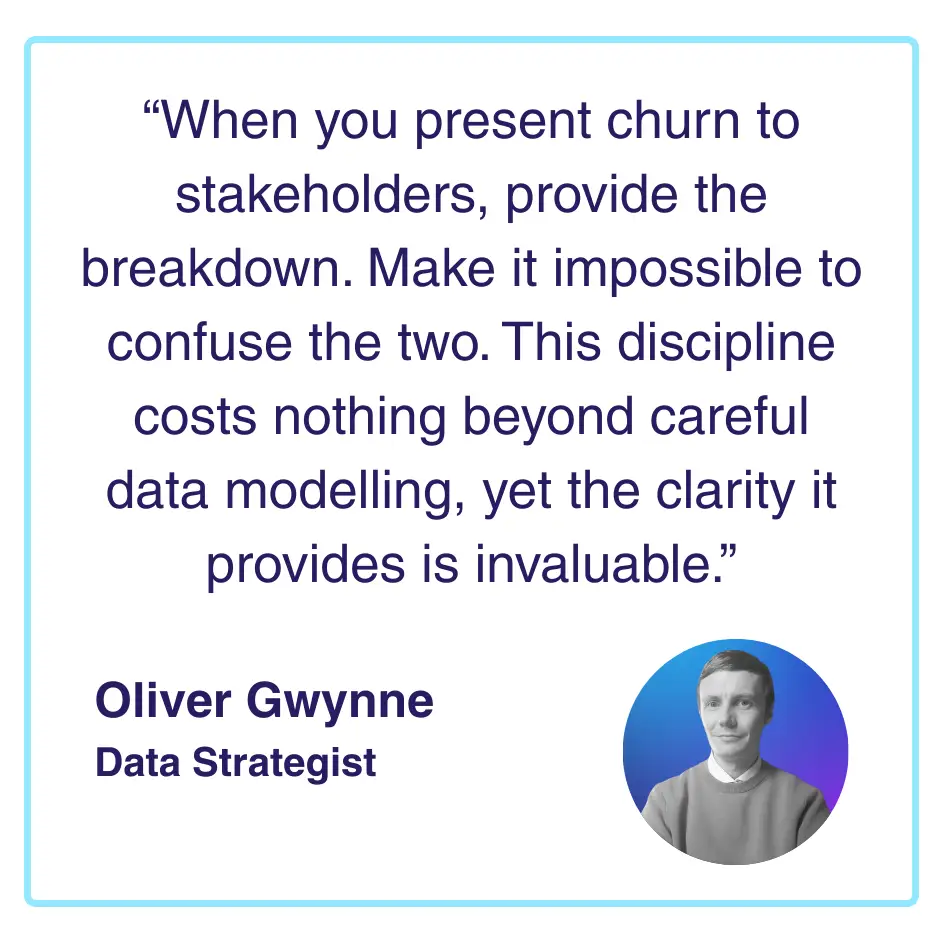
Every subscription business tracks churn. Most subscription businesses track it wrong. The mistake is treating churn as a single number, a unified metric that captures customer attrition. In reality, churn is not one phenomenon but several distinct phenomena that happen to share a superficial similarity: customers stop paying. The reasons they stop paying, and the implications for the business, differ profoundly.
Voluntary churn occurs when a customer makes an active decision to cancel. They no longer need your product. They found a competitor they prefer. Your pricing increased beyond what they are willing to pay. They had a negative experience with your service. Voluntary churn reflects product-market fit, competitive positioning, and customer satisfaction. It is a signal about the value you deliver.
Involuntary churn occurs when a customer’s payment fails. Their credit card expired. Their bank declined the charge. Their account lacks sufficient funds. The customer has not actively chosen to leave. In many cases, they would prefer to remain a customer. They simply have not updated their payment information. Involuntary churn reflects the mechanics of payment processing, the effectiveness of dunning strategies, and the administrative overhead of maintaining subscriptions. It is a signal about operational efficiency.
These are fundamentally different problems requiring different solutions. Reducing voluntary churn means improving the product, refining the pricing, enhancing customer success initiatives. Reducing involuntary churn means optimising payment retry logic, implementing proactive card updater services, and improving communication around payment failures. If you track only aggregate churn, you cannot distinguish between these failure modes. You know the symptom but not the diagnosis.
Moreover, the distinction matters for forecasting and valuation. Investors and acquirers scrutinise churn carefully, and they care about the breakdown. A company with 5% total churn that comprises 3% voluntary and 2% involuntary is in a different position than a company with the same 5% total churn that comprises 4% voluntary and 1%involuntary. The former has a stickier product but less optimised payment infrastructure. The latter has operational excellence but a weaker value proposition. These require different strategic responses.
Yet many companies track only a single churn number, or worse, they conflate the two types inconsistently. A subscription that cancels voluntarily is counted as churn immediately. A subscription that fails payment is counted only after multiple retry attempts and a grace period. The aggregate number becomes meaningless, a blend of two different time horizons and two different processes. Analysing trends in such a metric is futile.
The solution is straightforward: track voluntary and involuntary churn separately from the beginning. Your event log should distinguish between cancellation events initiated by the customer and cancellation events triggered by payment failure. Your churn calculations should report both metrics independently.

The Hidden Lifecycle Of Transitions
Subscription businesses are not binary. Customers do not simply exist or not exist, pay or not pay. They move through a complex lifecycle involving states that are neither fully active nor fully churned. Free trials. Downgrades. Expansions. Pauses. Reactivations. Each of these transitions contains information about customer behaviour and product stickiness, yet many businesses track them poorly or not at all.
Free trials are particularly problematic. On paper, a trial user is not yet a customer. They have not paid. They can walk away without consequence. Yet for analytical purposes, trials are essential to track. The conversion rate from trial to paid subscription is a critical metric. The characteristics of users who convert versus those who do not provide insights into product-market fit. The length of the trial period affects conversion rates and must be accounted for in cohort analysis. If trial users are invisible in your data model, or if they appear only as a gap between acquisition date and first payment, you have lost critical context.
Equally important are expansions and contractions: the moments when a customer changes their commitment level. A customer who starts on a basic plan and later upgrades to a premium tier is exhibiting entirely different behaviour than a customer who starts on premium and never changes. The former is experiencing increasing value. The latter may be satisfied or may simply lack awareness of additional features. These patterns are invisible if you track only current state rather than transition history.
Downgrades warrant particular attention. When a customer moves from a higher-tier plan to a lower-tier plan, it is tempting to count this as a partial churn, a loss of revenue. But the customer has not left. They are signalling something more nuanced: the higher tier was not worth the price, but the product itself still has value. This is actionable intelligence. Perhaps the pricing is misaligned. Perhaps the feature set does not justify the premium. Perhaps the customer’s needs have changed. A downgrade is not the same as churn, and treating it as such obscures important signals.
The same logic applies to pauses and reactivations. Some businesses allow customers to temporarily suspend their subscriptions, particularly in seasonal industries or for products with intermittent use cases. If your data model does not accommodate paused subscriptions as a distinct state, they appear as either active (inflating monthly recurring revenue) or churned (overstating churn rates). Reactivations, where a previously churned customer returns, are similarly valuable to track. A customer who churns and returns within three months is behaving differently than one who returns after two years, and both are behaving differently than a customer who never churned at all.
The solution is to model these transitions explicitly. Your event log should capture trial starts, trial conversions, upgrades, downgrades, pauses, reactivations, and cancellations as distinct event types. Your subscription entity should track its full history of plan changes, not just the current state. Your analytics should report on each transition type independently, enabling you to understand the full lifecycle rather than a simplified binary view. This richness of data enables nuanced analysis that a crude active-or-churned dichotomy cannot provide.
Expert help is only a call away. We are always happy to give advice, offer an impartial opinion and put you on the right track. Book a call with a member of our friendly team today.
The Brittleness Of Business Logic
One of the most damaging patterns in subscription data infrastructure is the embedding of business logic directly into the raw data layer. It happens gradually and often with good intentions. A report needs a calculated field. Rather than compute it at query time, an engineer adds a column to the database table and populates it with a script. The logic works. The report runs faster. The pattern is reinforced. Over time, the data layer accumulates dozens or hundreds of these calculated fields, each encoding business rules that seemed obvious at the time but become opaque as the team turns over and the business evolves.
The problem manifests when the business logic changes. Suppose your company originally defined monthly recurring revenue as simply the sum of all active subscription amounts. Later, you decide that trial subscriptions should not count toward monthly recurring revenue, even if they technically have a non-zero amount. If monthly recurring revenue is calculated at query time from raw subscription data, you change the query logic and rerun historical reports with the new definition. If monthly recurring revenue is stored as a column in the subscription table, you face a dilemma: do you recalculate and backfill all historical records, or do you accept that historical data reflects the old definition whilst new data reflects the new definition? Both options are painful.
The brittleness compounds when multiple calculated fields depend on each other. Monthly recurring revenue feeds into calculations of customer lifetime value. Customer lifetime value informs customer acquisition cost payback period. If the definition of monthly recurring revenue changes, every downstream metric must be recalculated. But if those metrics are stored as calculated columns rather than computed dynamically, the recalculation becomes a complex migration project. The longer this goes on, the more entangled the dependencies become, until eventually the system is so brittle that no one dares change anything for fear of breaking historical analyses.
Moreover, embedding business logic in the data layer obscures what the logic actually is. A future analyst looking at a database table sees columns labelled monthly recurring revenue and customer lifetime value but has no insight into how those values were calculated, what assumptions were made, or when the calculation was last updated. The data becomes a black box, trusted out of necessity but not out of confidence.
The principle to follow is simple: store raw data in the data layer, and compute business logic at the transformation or query layer. Your database should contain customers, subscriptions, plans, transactions, and events in their most granular form. This approach requires discipline. It is tempting to optimise for query performance by pre-calculating and storing results. Sometimes that optimisation is necessary. But when it is necessary, the calculated fields should live in a separate layer clearly designated as derived data, with lineage back to the raw inputs and documentation of the transformation logic. The raw data layer remains pristine, capturing only what actually happened, not what that means according to current business rules.

Building for Flexibility and Auditability
The antidote to these common mistakes is not merely avoiding specific errors but adopting a design philosophy that makes the system resilient to evolving requirements and transparent in its operation. Flexibility and auditability are not features you add at the end. They are properties that emerge from foundational design choices.
Flexibility means anticipating change without over-engineering for hypothetical futures. You cannot predict every way your business model will evolve, but you can structure your data to accommodate change. This means preferring narrow tables with clear semantics over wide tables with many columns. It means storing temporal information explicitly rather than relying on snapshots. It means modelling state transitions as events rather than as mutable records. When a subscription changes plans, do not overwrite the plan identifier. Create a new record or emit an event capturing the change. This preserves history and allows you to reconstruct the state of the business at any point in time.
Flexibility also means decoupling data capture from data interpretation. Your subscription table should not have a column called is_high_value_customer that encodes a specific definition of high value. Instead, your subscription table should have factual fields like monthly recurring revenue amount, contract length, and payment history, and the definition of high-value customer should live in the analytics layer where it can be adjusted without schema changes. The raw data remains constant even as the business evolves its segmentation strategy.
Auditability means that every number can be traced back to its source, and every calculation can be reproduced. When a stakeholder questions a metric, you should be able to show the query that generated it, the transformation logic that fed into it, and the raw records that ultimately determine the result. This requires investment in tooling and process. Version control for transformation code. Documentation of metric definitions. Data lineage tracking that shows which tables and fields contribute to each report. Access logs that reveal who ran which queries when.
Auditability also means immutability wherever practical. Raw event data should never be deleted or modified. If an event was recorded incorrectly, emit a correction event rather than editing the original. If a subscription record needs updating, prefer append-only patterns that preserve the previous state. This creates a complete audit trail, which is invaluable not only for debugging discrepancies but also for compliance and forensic analysis when something goes wrong.

Conclusion
Avoiding common mistakes in subscription data is not a matter of technical sophistication. The tools and techniques required are well-established and accessible. The challenge is cultural and organisational. It requires resisting the pressure to take shortcuts, to accept convenient but flawed defaults, to defer difficult design decisions until later. It requires investing time in the unglamorous work of defining metrics precisely, documenting transformations thoroughly, and building systems that remain comprehensible as they scale.
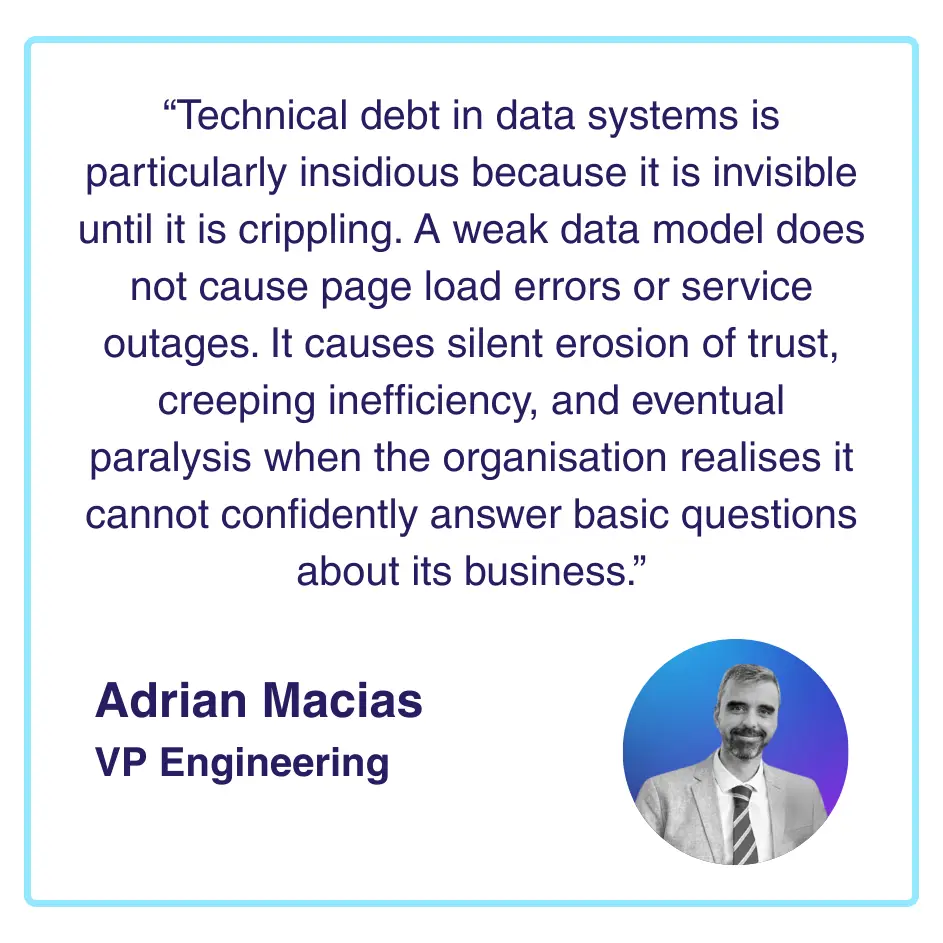
The return on this investment is compounding. A well-architected data foundation enables increasingly sophisticated analysis without requiring constant refactoring. A transparent and auditable system builds trust, allowing the organisation to make decisions with confidence. A flexible design accommodates growth and evolution without accumulating crippling technical debt. The discipline is hard. The alternative is harder.
Get In Touch
Our friendly team are always on hand to answer questions, troubleshoot problems and point you in the right direction.
