
Introduction To
Revenue Intelligence
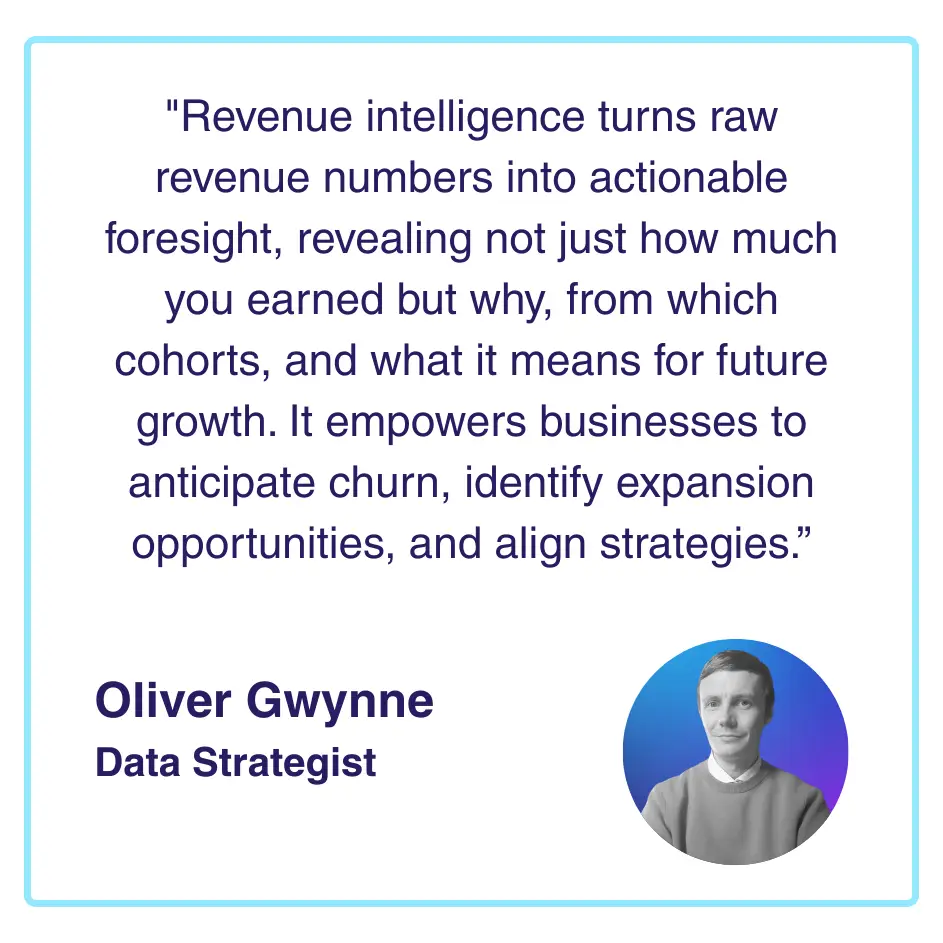
Revenue is the most fundamental metric in business, yet most organisations treat it as a simple output to be measured rather than a complex system to be understood. They track top-line numbers, celebrate increases, worry about decreases, but lack the analytical infrastructure to understand why revenue behaves the way it does or how to influence it systematically. Revenue intelligence tells you why it happened, what it means for the future and which interventions could shift these trajectories.
For SaaS and subscription businesses, this distinction carries particular weight because revenue is not a one-time event but an ongoing relationship. Every customer represents not just their initial purchase but their potential expansion, likelihood of renewal, vulnerability to churn, and capacity to refer others. Understanding these dynamics requires moving beyond simple revenue tracking toward sophisticated intelligence systems that connect revenue outcomes to the behaviours and patterns that drive them.
What Revenue Intelligence Is
Revenue intelligence is the discipline of transforming raw revenue data into predictive insights about customer behaviour, business health, and strategic opportunities. It is the difference between knowing revenue increased 15% last quarter and understanding that the increase came primarily from enterprise expansion, that SMB churn accelerated, that new customer acquisition actually declined, and that current trends project deceleration in three months unless specific interventions occur.
Traditional revenue tracking focuses on aggregate metrics; total revenue, growth rates, customer counts. These are essential for financial reporting but obscure the underlying dynamics that determine whether growth is sustainable or fragile, whether customer relationships are strengthening or weakening, and whether strategies are building long-term value or manufacturing short-term results.
Revenue intelligence disaggregates these aggregates, examining revenue composition at granular levels. It asks not just “How much?” but “Which cohorts generated it? Through which channels? From which products? As expansions or new acquisitions?” Each dimension reveals different patterns, and their interactions reveal the true structure of your business.
For subscription businesses, revenue intelligence matters intensely because business models are fundamentally about customer relationships over time rather than one-time transactions. The customer who purchases today represents not just today’s revenue but the stream of future revenue through renewals and expansions, offset by churn probability. Understanding this temporal dimension; how customer value evolves, which factors drive evolution, how to influence trajectories, separates successful subscription businesses from those churning through customers as fast as they acquire them.
The specific challenges revenue intelligence addresses include: predicting churn before it manifests in cancellations, identifying expansion potential before customers request upgrades, understanding which acquisition sources produce high versus low lifetime value customers, detecting early signals of business model problems before they appear in aggregate metrics, and quantifying the revenue impact of product changes, pricing adjustments, or go-to-market shifts.
Each challenge requires connecting revenue outcomes to leading indicators; the behavioural signals, usage patterns, and engagement metrics that predict future revenue movements. A customer whose usage has declined 40% over three months probably has elevated churn risk even without cancelling yet. A customer who has adopted advanced features and invited team members probably has expansion potential even without requesting upgrades. Revenue intelligence is the framework for systematically identifying these patterns and acting proactively rather than reactively.

Which Metrics To Track?
The three core systems of revenue intelligence; MRR tracking, revenue recognition, and expansion/contraction analysis, serve distinct purposes but work together to create comprehensive understanding of business dynamics.
Monthly Recurring Revenue captures the ongoing nature of customer relationships. Unlike traditional revenue metrics measuring completed transactions, MRR measures current run rate, the monthly value of all active subscriptions. This forward-looking perspective makes MRR valuable for understanding trajectory rather than just historical performance.
MRR is most useful when you break it down into its individual components: previous period’s MRR, plus new MRR from acquired customers, plus expansion MRR from upgrades, minus contraction MRR from downgrades, minus churned MRR from cancellations. This reveals the engines of growth and sources of friction within your business.
Patterns emerge that aggregate numbers conceal. You might discover you are adding new MRR steadily but churn is accelerating, creating a leaky bucket where growth depends on ever-increasing acquisition rather than compounding customer value. Or new customer acquisition has stalled but expansion revenue is strong, suggesting solid product-market fit with existing customers but go-to-market needing adjustment.
The actionable insight comes from connecting movements to their drivers. High churn is not just a number, it’s specific customer cancellations, each with its own story. When you analyse churned customers by cohort, acquisition channel, product usage, or segment, patterns emerge. Customers from a specific channel churn at twice the rate of others. Customers who never adopted a particular feature churn at three times baseline. These patterns transform churn from an abstract metric to a targetable problem with specific interventions for specific segments.
Revenue recognition ensures financial reporting reflects economic reality rather than cash timing. When a customer pays £12,000 for an annual subscription, that’s cash immediately, but revenue is earned gradually over twelve months as you deliver service. Recognition rules require recognising only the earned portion each period, deferring the remainder as liability until earned. For intelligence purposes, the gap between billings (cash received) and recognised revenue (value delivered) contains important signals. Increasing deferred revenue indicates you’re selling more annual contracts or customers are prepaying for longer periods, both positive indicators of customer confidence. Decreasing deferred revenue might signal a shift toward monthly billing, potentially indicating customer hesitation about longer commitments. More sophisticated analysis examines how different segments contribute to deferred revenue balances. If enterprise customers typically purchase annual contracts whilst SMB customers prefer monthly billing, your deferred revenue composition reflects customer mix. Changes in composition signal shifts in which segments are growing or contracting, providing leading indicators of business model evolution.
Expansion and contraction tracking measures how customer value evolves after initial purchase. Net revenue retention (the percentage of revenue retained from a cohort over time, including both churn and expansion) has become arguably the most important SaaS metric because it reveals whether you’re building compounding customer value or treading water. Net revenue retention above 100% means your existing customer base grows in value before adding new customers. This creates powerful compounding dynamics where each cohort becomes more valuable over time, accelerating growth without proportionally increasing acquisition costs. Below 100% means you’re losing ground with existing customers, growth requires constantly replacing lost revenue through new acquisition, creating a difficult-to-sustain treadmill. Actionable insights come from understanding what drives movement in each direction.
Expansion typically follows specific triggers; adding team members, adopting new features, reaching usage thresholds, integrating additional systems. Identifying these triggers and their timing allows you to optimise product and go-to-market motion to encourage them. Contraction (customers downgrading or reducing spend) often signals problems before churn occurs. Understanding why contraction happens allows targeted intervention to reverse the trend or slow its progression. When these three systems work together, they create comprehensive visibility. MRR movements show what’s happening. Revenue recognition ensures financial accuracy and reveals cash flow dynamics. Expansion/contraction tracking shows whether customer relationships are strengthening or weakening.
Expert help is only a call away. We are always happy to give advice, offer an impartial opinion and put you on the right track. Book a call with a member of our friendly team today.
Revenue Data vs Revenue Intelligence
Revenue data comprises the facts: transactions processed, invoices sent, payments received, subscriptions started or cancelled. These facts are essential, accurate data is the foundation of any intelligence system. But data alone does not tell you why things happened, what they mean for the future, or how you should respond.
Revenue intelligence emerges from analysing data in context, identifying patterns across dimensions, connecting outcomes to drivers, and building predictive models. Consider a simple example: your revenue grew 10% last quarter. That’s data. Intelligence asks why. Was growth driven by new acquisition, existing expansion, or combination? Which segments contributed? Which channels? Did segments contract whilst others grew, creating compositional shifts affecting future trajectory?
Intelligence might reveal that whilst aggregate growth was 10%, this masks divergent performance. Enterprise revenue grew 25% through expansion, but SMB revenue declined 5% through elevated churn. New acquisition was flat. This paints a completely different picture, growth comes from a specific segment and mechanism (expansion, not acquisition), whilst another segment deteriorates.
Each analytical layer adds intelligence: Which specific enterprise customers expanded and why? Are there common characteristics or triggers? Can these patterns be replicated? Why is SMB churn elevated? Is it pricing, product fit, competitive displacement, or market dynamics? Is flat acquisition due to reduced spend, declining conversion, or shifts in demand?
The data, transactions and movements, does not answer these questions. Intelligence comes from combining data with additional context (customer characteristics, usage patterns, competitive dynamics) and analytical frameworks (cohort analysis, predictive modelling, segmentation) that extract meaning from patterns.
Another distinction is temporal: data is historical, intelligence is predictive. Data tells you churn was 5% last month. Intelligence tells you that based on current usage patterns and engagement signals, churn will likely be 7% next month unless specific interventions occur with specific cohorts. Data reports what happened; intelligence forecasts what will happen and identifies levers that could change those forecasts.
Building revenue intelligence requires infrastructure beyond basic tracking. You need data integration connecting revenue movements to customer characteristics, product usage, and engagement patterns. You need analytical frameworks for segmentation, cohort analysis, and predictive modelling. You need visualisation tools making patterns visible rather than buried in spreadsheets. You need organisational processes translating intelligence into action rather than letting insights languish in unread reports.
Perhaps most importantly, you need analytical culture, the habit of asking “why” rather than accepting surface metrics, the discipline to dig into anomalies rather than dismissing them as noise, and the intellectual honesty to follow data even when it contradicts assumptions.


How Revenue Intelligence Improves Your Business
The practical value of revenue intelligence manifests across business operations, but three domains show particularly clear returns: customer value optimisation, retention improvement, and strategic decision quality.
Customer value optimisation begins with understanding that not all customers are equally valuable and that value evolves over time. Revenue intelligence identifies which customer characteristics predict high lifetime value: company size, industry, acquisition channel, initial plan selection, usage patterns, feature adoption. With this understanding, you can focus acquisition on high-value segments rather than pursuing volume indiscriminately. More sophisticated optimisation examines the journey from initial purchase to eventual churn or expansion. Some customers remain at their initial plan indefinitely. Others expand rapidly through seat additions, upgrades, or add-ons. Intelligence identifies the triggers and timing of expansions; the usage thresholds, feature adoptions, or organisational changes that precede upgrades. Armed with this knowledge, you can design products and customer success motions encouraging expansion triggers. If customers who adopt Feature X typically upgrade within 90 days, prioritise getting customers to adopt Feature X. If customers reaching 80% of plan limits typically upgrade rather than churn, structure plans to create these decision points at appropriate intervals.
Retention improvement represents perhaps the most valuable application because reducing churn has compounding effects on growth. Every percentage point of churn reduction compounds over time; customers who would have left instead stay and potentially expand, creating a larger base for future growth. Intelligence improves retention by identifying churn signals before cancellation occurs. Usage declining, engagement dropping, support tickets increasing, payment failures accumulating, each indicates elevated churn risk. When you track these signals systematically and connect them to eventual outcomes, you build predictive models identifying at-risk customers weeks or months before cancellation. This early warning enables proactive intervention. Rather than responding to cancellation requests, you reach out to at-risk customers proactively; addressing concerns, improving onboarding, demonstrating undiscovered value, or offering pricing adjustments if appropriate. Not every at-risk customer can be saved, but intervening before they have mentally checked out produces far better results than trying to win back customers who have already decided to leave. Intelligence also reveals which retention interventions work for which segments. Enterprise customers might respond to executive business reviews. SMB customers might respond to improved onboarding and tutorials. Rather than uniform retention efforts, intelligence enables targeted interventions calibrated to specific churn drivers in specific segments.
Strategic decision-making improves when informed by revenue intelligence because decisions can be evaluated based on expected impact on specific revenue drivers rather than intuition. Should you invest in building Feature Y? Intelligence about which features drive retention and expansion among high-value segments can inform that decision far better than product manager intuition or customer feedback volume. Should you expand into a new market segment or geography? Intelligence about customer acquisition costs, conversion rates, lifetime values, and retention characteristics in existing segments provides benchmarks for evaluating whether new segments will likely be profitable. Should you adjust pricing? Intelligence about price elasticity across segments, the relationship between price and lifetime value, and competitive positioning informs pricing decisions with data rather than guesswork. Revenue intelligence also improves capital allocation, how much to spend on sales and marketing, whether to prioritise new acquisition versus expansion, how aggressively to invest in growth versus profitability. These decisions fundamentally shape business trajectory, and intelligence about unit economics, payback periods, and lifetime value by segment makes them answerable through analysis rather than executive intuition. The compounding effect of better decisions across thousands of choices, which features to build, which segments to target, how to price, how to structure customer success, which channels to invest in, is the difference between businesses that grow efficiently and profitably versus those that grow expensively and unsustainably.


Conclusion
Revenue intelligence is not a feature of your finance system or a dashboard you purchase, it exists wherever your data is integrated and accessible in one place. By connecting transactional data, product usage, engagement signals, and customer characteristics, you can move beyond historical reporting to a predictive, actionable understanding of your business. It’s the synthesis of these datasets; structured, segmented, and analysed, that transforms raw revenue numbers into intelligence: insights that reveal why revenue moves, which levers to pull, and how to optimise customer value, retention, and growth strategically. Ultimately, revenue intelligence is defined not by the tools you use but by the ability to unify your data, ask the right questions, and act on the answers.
Get In Touch
Our friendly team are always on hand to answer questions, troubleshoot problems and point you in the right direction.
