
Freemium & Free Trials
The prevailing mythology around freemium pricing treats it as a generous marketing gesture, a way to let customers “try before they buy” that removes friction from the sales process and accelerates adoption. This framing fundamentally misunderstands what freemium actually is and why it succeeds or fails.
Freemium is not primarily a marketing tactic designed to lower acquisition costs or speed up sales cycles. It is a data collection engine that generates continuous information about customer behaviour, value perception, and conversion dynamics that would be impossible to obtain through any other mechanism.
When companies launch freemium offerings without this understanding, they typically make predictable errors. They design the free tier based on intuition about what features to gate rather than systematic analysis of what drives conversion. They measure success through vanity metrics like signup volume rather than conversion quality and lifetime value. They treat the free tier as a static offering rather than an experimental platform for learning about customer behaviour. The result is freemium tier that generate substantial costs; infrastructure, support, opportunity cost of cluttered positioning, without proportional revenue returns.
The True Purpose Of Freemium
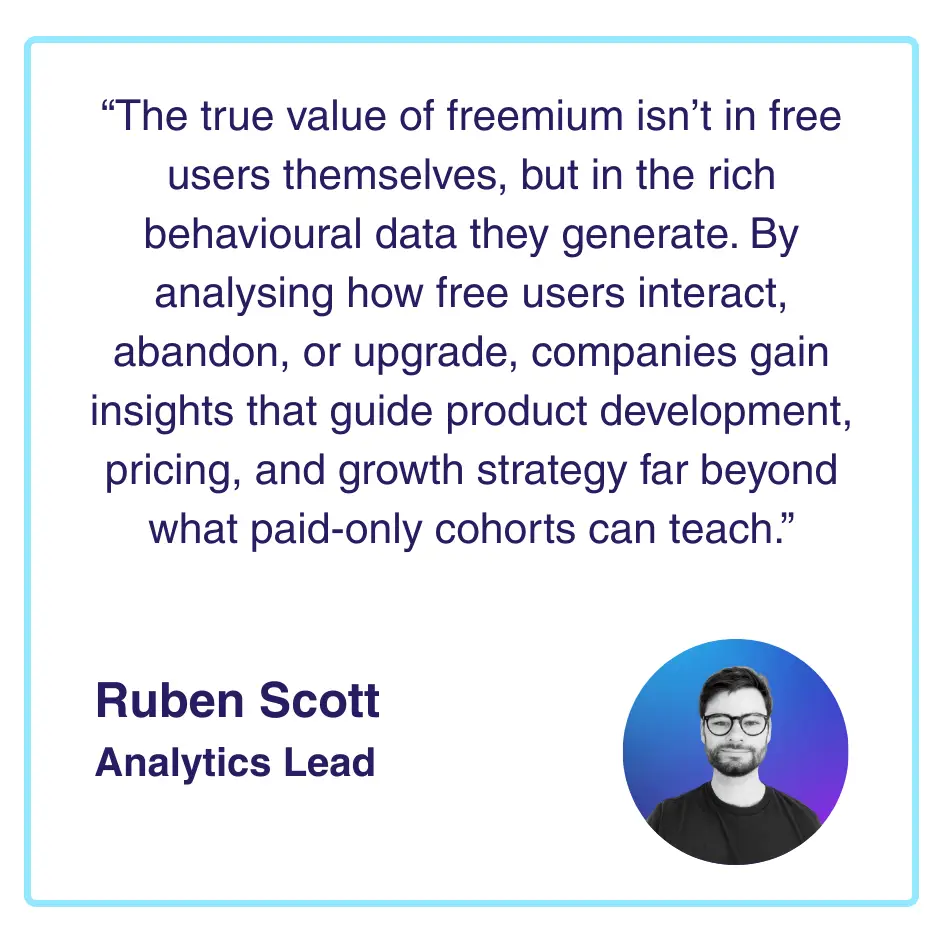
The strategic value of freemium lies not in its marketing appeal but in its capacity to generate behavioural data that reveals customer needs, value perception, and conversion dynamics. Every interaction a free user has with your product produces signals about what works, what confuses, what delights, and what drives payment decisions. The volume and richness of this data vastly exceeds what you can obtain from paid customers alone or from traditional market research.
Free usage reveals activation struggles with brutal clarity. Paid customers have strong incentive to push through onboarding friction, they have made a financial commitment and need to justify it. Free users have no such incentive. They abandon immediately when onboarding is confusing, when value is not immediately apparent, when setup requires too much effort. This ruthless attrition functions as a diagnostic tool that shows you exactly where your product fails to communicate value or create early success.
The specific points where free users abandon en masse indicate onboarding failures that likely affect paid customers as well, though paid customers persevere through them. If 60% of free signups never complete initial setup, your paid customers are probably struggling with the same setup process but gritting their teeth through it. If free users consistently abandon after viewing a particular feature or setup screen, that element is creating confusion or disappointment that is costing you conversions.
Feature value becomes measurable through free tier usage patterns in ways that customer interviews and surveys can never achieve. Customers will tell you that Feature X is critical and that they absolutely need Feature Y, but their actual behaviour reveals what they genuinely value. Free users adopt features that deliver immediate, tangible value and ignore features that do not, regardless of how those features are positioned or marketed.
This information is gold for both product development and pricing decisions. Features with high adoption and strong correlation to conversion should be prominent in your value proposition and potentially gated to drive upgrades. Features with low adoption despite prominent positioning indicate either product-market misalignment or messaging failures that need addressing.
Upgrade triggers (the specific moments or conditions that cause free users to convert to paid plans) become visible through cohort analysis and conversion event tracking. Some users convert immediately after experiencing a particular feature. Others convert when they hit usage limits. Others convert when they need to invite team members or integrate with other tools. Understanding the distribution of these triggers across your user base tells you where to focus conversion optimisation efforts and how to structure your upgrade paths.
The data collection capacity of freemium extends beyond individual user behaviour to market-level insights. Geographic distribution of free signups reveals where demand exists before you invest in regional expansion. Seasonal patterns in signup and conversion inform everything from marketing spend allocation to product release timing. The true purpose of freemium, then, is not to give away your product in hopes that some percentage converts. It’s to build a learning engine that generates continuous feedback about customer behaviour, value perception, and conversion dynamics.

The Three Types of Freemium Models
Freemium structures typically fall into three archetypal models, each with distinct behavioural economics and strategic implications. Understanding which model fits your product and market requires analysing not just what gates would be easiest to implement but which creates the right conversion dynamics for your business model and customer segments.
Capacity-limited freemium; exemplified by Notion, Slack, and similar products, allows access to full functionality but constrains usage through quantitative limits. You can use all features but only create a certain number of pages, send a certain number of messages, or store a certain amount of data. The conversion trigger is hitting these capacity limits, which happens naturally as usage grows. Users experience the complete product without artificial feature restrictions, which allows them to fully understand its value and build genuine usage patterns. The conversion pressure emerges organically from their own success, they are converting not because you have locked away features they want but because their usage has grown beyond free tier limits. This creates positive conversion sentiment rather than resentment about artificial restrictions.
The challenge with capacity-limited models is calibrating limits correctly. Set them too low and users hit limits before experiencing sufficient value to justify paying, creating frustration rather than conversion. Set them too high and users comfortably exist within the free tier indefinitely, never experiencing conversion pressure. The right limit is the point where users have established clear value but are actively constrained by the boundary. This requires continuous experimentation and segment-specific analysis. Power users in high-value segments should hit limits relatively quickly, creating natural upgrade pressure for the customers you most want to convert. The art is structuring limits so they create conversion pressure where you want it without creating friction where you do not.
Feature-limited freemium: exemplified by Canva, LinkedIn, and countless others, provides access to core functionality in the free tier whilst gating premium features behind paid plans. The conversion trigger is wanting access to locked capabilities, advanced editing tools, premium templates, additional integrations, priority support.
The behavioural economics here are more complex. Users can experience sufficient value to build usage habits in the free tier, but premium features create aspiration and conversion intent. The model works when the gated features represent genuine upgrades that enhance the core experience rather than essential functionality that should be accessible to all users. When designed well, users feel they are upgrading to access better tools, not paying to unlock basic usability. The challenge is choosing which features to gate. Gate too many core features and the free experience feels crippled, preventing users from experiencing sufficient value to convert. Gate too few premium features and the paid tiers do not create compelling differentiation. The right approach typically involves making the free tier genuinely useful for basic use cases whilst gating capabilities that matter primarily to power users or professional contexts.
Feature-limited models require careful monitoring of feature adoption patterns. If free users regularly attempt to access gated features but do not convert, you have either priced the upgrade incorrectly or failed to demonstrate sufficient value to justify the cost. If free users rarely try to access gated features, those features might not be creating the aspirational pull you intended, or you might be attracting users who don’t need professional capabilities.
Time-limited freemium, perhaps more accurately called free trials but often grouped with freemium, provides full access to all features for a limited period, after which access expires or converts to a restricted free tier. The conversion trigger is wanting to maintain access beyond the trial period. This create urgency and force evaluation. Users know they have limited time to assess the product, which concentrates attention and accelerates decision-making. The model works particularly well for products with longer learning curves or complex workflows where users need substantial time investment to experience full value. The trial period allows this investment whilst creating a deadline for conversion decisions.
The challenge with time-limited models is that they require users to experience sufficient value within the trial window to justify paying. If your product requires three months of usage before value becomes clear but you offer a 14-day trial, conversion will suffer because users have not experienced enough to make informed purchase decisions. If your trial is too long, conversion urgency dissipates and users defer decisions indefinitely. Time-limited models also struggle with certain user psychology. The deadline creates pressure but also creates loss aversion, users who have not fully explored the product within the trial window often abandon rather than pay, because they feel they have not adequately evaluated whether it’s worth the cost. This differs from capacity or feature-limited models where users can take as long as they need to evaluate value before hitting conversion triggers.
The strategic choice between these models depends on your product characteristics, customer segments, and business objectives. Products with clear usage metrics (documents created, emails sent, records stored) naturally fit capacity-limited models. Products with sophisticated feature sets and clear power-user capabilities naturally fit feature-limited models. Products requiring significant learning investment or evaluation time might benefit from time-limited trials followed by restricted free tiers.
Many successful products use hybrid approaches, combining capacity limits with feature gates, or offering time-limited trials that convert to capacity-limited free tiers. The sophistication lies not in choosing a pure model but in understanding which combination of conversion triggers creates the right dynamics for your particular context. This requires experimentation, measurement, and willingness to iterate based on actual conversion behaviour rather than theoretical preferences.
Expert help is only a call away. We are always happy to give advice, offer an impartial opinion and put you on the right track. Book a call with a member of our friendly team today.
How Freemium Users Self-Segment
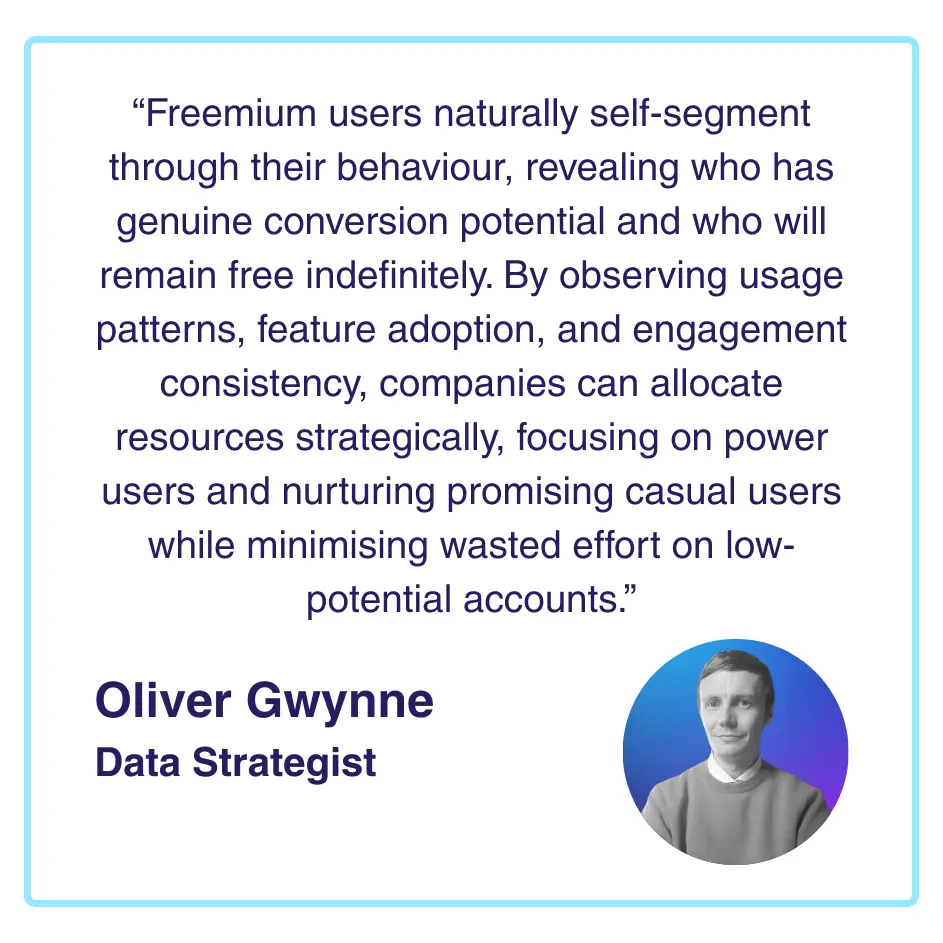
One of the most powerful aspects of freemium is that users naturally sort themselves into segments through their behaviour, revealing who represents genuine conversion opportunity versus who will remain free indefinitely. Understanding these self-segmentation patterns allows you to allocate resources strategically rather than treating all free users identically.
Power Users
Power Users hit limits quickly and consistently, creating immediate and recurring conversion pressure. These users adopt the product deeply, integrate it into regular workflows, and push against boundaries rapidly. Their behaviour signals high engagement, clear value perception, and strong conversion potential. When power users reach capacity limits or attempt to access gated features, they are experiencing genuine constraints on usage they already value, creating natural upgrade intent.
The strategic priority with power users is reducing friction in the conversion path rather than creating additional conversion pressure. They are already motivated to upgrade, your job is making it easy, clear, and compelling. This might mean proactive outreach when they approach limits, targeted messaging about specific premium features they have tried to access, or streamlined upgrade flows that require minimal decision-making.
Power Users also represent your best source of product feedback and feature requests. They are using the product extensively enough to have sophisticated opinions about what works and what does not. Their upgrade decisions are typically based on genuine need for additional capacity or features rather than casual interest, making their conversion feedback particularly valuable for understanding what drives payment decisions in your highest-value segment.
Casual Users
Casual Users rarely return after initial exploration, creating high volumes of inactive accounts that generate costs without conversion potential. These users might sign up with genuine interest, explore basic features, but never establish consistent usage patterns. They are not necessarily dissatisfied, they simply have not found sufficient value or have not prioritised integrating your product into regular workflows. The challenge with casual users is distinguishing between those who have not yet discovered value (and could be nurtured into engagement) versus those for whom your product genuinely is not a fit. Early engagement patterns provide signals, users who complete onboarding and adopt at least one core feature have reasonable conversion potential. Users who sign up but never complete setup or who explore features briefly without adopting any workflows are unlikely to convert regardless of intervention.
The strategic approach to Casual Users is typically minimal resource investment. Rather than aggressive conversion campaigns that annoy users who aren’t ready to engage, you implement automated nurture sequences that periodically remind them of the product’s existence and highlight relevant use cases. You monitor for engagement signals that indicate renewed interest and respond to those signals when they appear. But you do not invest substantial sales or support resources in users whose behaviour indicates low conversion probability.
Team Users
Team and workspace users convert at different speeds and through different mechanisms than individual users. A single user might explore your product extensively before converting, but when team adoption is involved, conversion dynamics change dramatically. One team member discovers the product, invites colleagues, adoption spreads through the organisation, and conversion happens when the team collectively decides the product is valuable enough to justify paying.
These team-based conversion patterns create both opportunities and challenges. The opportunity is that team adoption often leads to higher lifetime value; multiple seats, stronger lock-in through collaborative workflows, lower churn because switching requires coordinating multiple people. The challenge is that conversion cycles are longer and less predictable because they involve consensus-building rather than individual decisions.
The strategic approach to Team Users involves facilitating rather than forcing conversion. Make it easy to invite colleagues, create value from collaborative usage, and demonstrate ROI at the team level rather than just individual level. Conversion messaging should address team benefits; coordination, shared assets, unified workflows, rather than just individual productivity. Pricing should accommodate team adoption patterns, potentially through discounted multi-seat plans or gradual expansion pricing.
The key insight is that freemium users self-segment through their behaviour far more accurately than any demographic or firmographic data could achieve. You do not need to guess which free users represent valuable conversion opportunities, they tell you through their usage patterns, feature adoption, and engagement consistency. Your job is to instrument these behaviours properly, analyse the resulting patterns systematically, and respond strategically rather than uniformly

Experimenting Inside Freemium
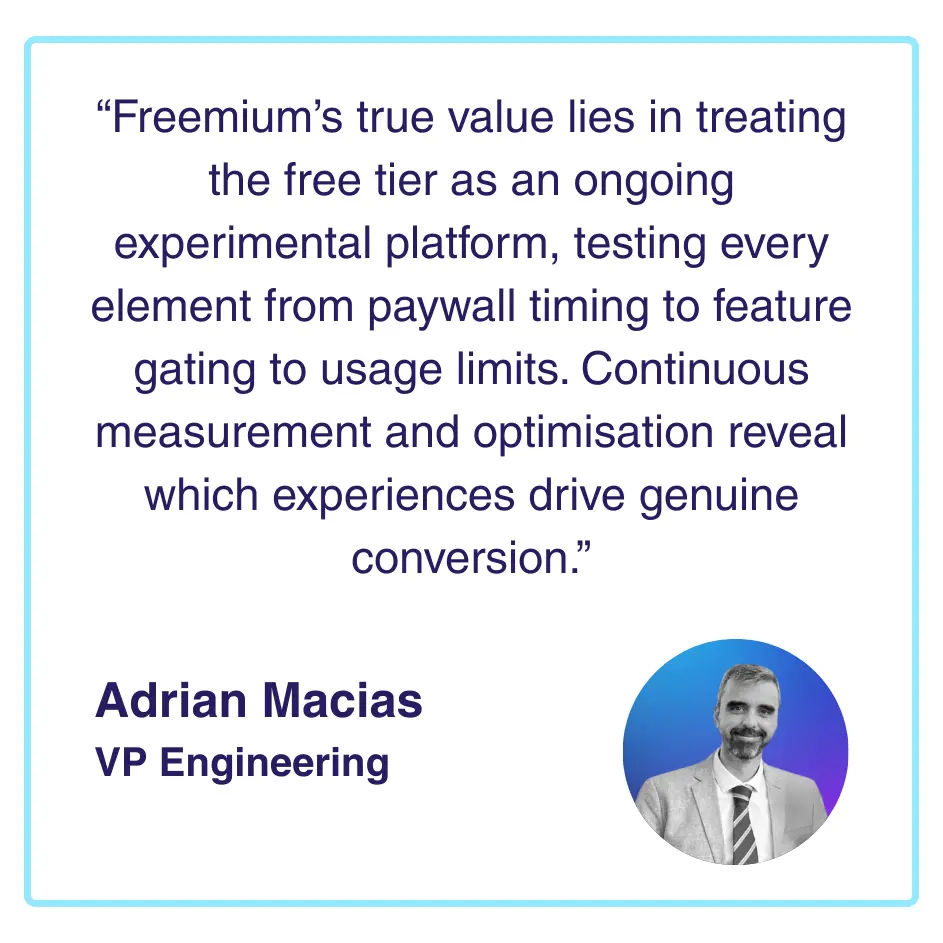
The true power of freemium as a data collection engine emerges when you treat the free tier as an experimental platform for continuous learning about conversion mechanics, value perception, and optimal product structure.
Paywalls
Moving paywalls to earlier or later moments in the user journey dramatically affects both conversion rates and conversion quality. A paywall encountered immediately after signup converts users who already have strong purchase intent but allows users with weak intent to churn before experiencing any value. The optimal paywall timing depends on how quickly users can experience meaningful value and how strong your competitive alternatives are. Products with immediate value propositions (“aha” moments that happen within minutes) can gate aggressively early without destroying conversion. Products requiring substantial investment before value becomes clear need to delay conversion pressure until users have experienced sufficient value to make informed purchase decisions. Experimentation on paywall timing typically involves A/B testing different trigger points, days of usage, features accessed, limits approached, and measuring both immediate conversion impact and downstream metrics like retention and lifetime value. Early conversion might increase revenue per user but decrease overall revenue if it prevents users from experiencing enough value to become long-term customers.
Paid Features/Pricing Tiers
These experiments often reveal non-linear relationships between limits/tiers and conversion. Increasing a limit from 100 to 150 might have minimal impact on conversion whilst increasing from 150 to 200 might dramatically improve it, suggesting that 150 creates an awkward constraint that frustrates users without providing enough capacity to be genuinely useful. Finding these inflection points requires systematic testing rather than intuition.
Testing which features should be “aha” moments versus “paid advantages” fundamentally shapes your value proposition and conversion funnel. Some features create immediate engagement and should be freely accessible to demonstrate value quickly. Other features represent advanced capabilities that matter primarily to power users and should be gated to drive conversion from high-value segments. The challenge is that intuition about which features create “aha” moments often proves wrong. The feature you think is your compelling differentiator might generate minimal engagement amongst free users. A feature you considered minor might be the primary driver of sustained usage and eventual conversion. Only systematic measurement of feature adoption, engagement correlation, and conversion influence reveals which features belong in which category. This testing requires sophisticated analytics that connect feature usage to conversion outcomes. You need to track not just whether users adopt specific features but whether feature adoption predicts conversion, how quickly adoption leads to conversion, and whether conversion driven by specific features produces better long-term retention.
Micro Pricing
Micro-pricing inside of free tiers (offering credits, top-ups, or pay-per-use options) creates conversion opportunities that do not require full subscription commitment. Users who need occasional access to premium features but do not justify full paid plans can purchase temporary access, generating revenue from segments that pure subscription models cannot capture. The behavioural economics of micro-pricing are complex. On one hand, allowing users to pay small amounts for specific features or temporary access reduces commitment anxiety and allows value testing before subscription decisions. On the other hand, it can train users to think of your product in terms of individual transactions rather than ongoing value, potentially reducing subscription conversion by providing cheaper alternatives to commitment.
Whether micro-pricing makes sense depends on your product’s usage patterns and pricing structure. Products with occasional high-value use cases (design tools, video editing, data analysis) benefit from allowing users to pay for one-off projects without subscribing. Products with daily usage patterns that generate ongoing value (communication tools, project management, CRM) typically suffer when users can cherry-pick occasional use rather than committing to subscriptions.
The experimental mindset treats every element of freemium as a variable that can be tested and optimised. Trial lengths, feature gates, usage caps, upgrade messaging, limit warnings, conversion flows, all generate data about what drives conversion and what creates friction. The companies that succeed with freemium are those running continuous experiments on these variables, measuring results rigorously, and implementing improvements systematically.

Tracking The Right Metrics
The activation – engagement – conversion funnel represents the foundational framework for freemium analytics. Activation measures whether users successfully complete initial setup and experience core value. Engagement measures whether users return and establish ongoing usage patterns. Conversion measures whether users eventually pay. Each stage has different success criteria and different levers for optimisation.
Activation
Activation is arguably the most critical metric because users who never activate never reach the engagement or conversion stages. Yet many companies define activation poorly: as merely signing up or completing setup rather than experiencing genuine value. Proper activation definition requires identifying the specific action or outcome that predicts long-term engagement, whether that’s creating a document, sending a message, completing a workflow, or achieving some other meaningful milestone. Activation rates reveal whether your onboarding process successfully guides users to early value. Low activation suggests friction in setup, confusion about how to use the product, or misalignment between what you promised in marketing and what new users experience. Improving activation typically has outsized impact on conversion because users who never experience value never convert regardless of how compelling your paid features are.
Engagement
Engagement measures whether activated users establish ongoing usage patterns. This is not just about whether users return but whether they integrate the product into regular workflows. A user who logs in once per month is technically engaged but probably is not experiencing sufficient value to justify paying. A user who logs in daily and actively uses core features is genuinely engaged and represents strong conversion potential. Engagement metrics should distinguish between depth (intensity of usage during sessions) and frequency (consistency of return). Some products succeed with infrequent but deep usage, a design tool used weekly for intensive projects. Others require frequent but light usage, a communication tool checked multiple times daily. Understanding which pattern indicates healthy engagement for your product requires analysing the correlation between usage patterns and eventual conversion.
Aha Moments
“Aha moment” identification, finding the specific action or threshold that predicts conversion, transforms freemium optimisation from guesswork to science. This might be the user’s tenth project created, their first collaboration with a team member, their first successful automation, or their first integration with another tool. Once identified, the aha moment becomes your North Star metric, the experience you optimise onboarding to deliver as quickly as possible. Finding these magic moments requires cohort analysis that connects early behaviours to later outcomes. You track dozens or hundreds of potential signals: feature usage, session patterns, milestone achievements, and identify which ones correlate most strongly with eventual conversion. The magic moment typically isn’t the most popular feature or the feature you think is most important. It’s the specific experience that predicts users will derive enough value to justify paying.
Time-To-Upgrade
Time-to-upgrade curves reveal how long users typically spend in the free tier before converting and how this timeline varies across segments. Some products convert users quickly, within days or weeks of activation. Others have long conversion cycles, months or even years between signup and payment. Understanding your natural conversion timeline prevents premature optimisation efforts and helps calibrate expectations. These curves also reveal segment differences. Enterprise users might have longer evaluation cycles than SMB users. Team-based adoption might take longer than individual conversion. Users in certain industries or geographies might convert faster or slower. Identifying these patterns allows segment-specific conversion strategies rather than one-size-fits-all approaches that fail to account for natural differences in decision timelines.
Freemium-To-Paid
Freemium-to-paid lifetime value by cohort measures whether conversion from free tiers produces customers with comparable lifetime value to other acquisition channels. Some free conversions produce excellent customers who expand rapidly and retain well. Others produce customers who remain at minimum commitment and churn quickly. Understanding these patterns tells you whether freemium is generating the right kind of revenue or merely converting users who would never have paid through traditional acquisition. This analysis often reveals that not all freemium conversions are equally valuable. Users who hit usage limits and upgrade to access additional capacity often become excellent customers, they have demonstrated clear value perception and usage patterns that support expansion. Users who upgrade primarily for one gated feature might remain at minimum plans indefinitely. Users who convert only during promotional pricing might churn when prices normalise.
This more sophisticated metric framework tracks full-funnel economics, not just conversion rates but conversion quality, not just revenue but profitability, not just activation but sustained engagement. It requires connecting freemium analytics to billing systems, support costs, and lifetime value models. The goal is understanding whether freemium generates profitable customers at acceptable costs, not just whether it generates customers.


Ending Freemium Or Fixing It
Not every product benefits from freemium, and continuing to operate an unprofitable or strategically misaligned free tier represents a failure of business discipline rather than customer generosity. The question is not whether to offer freemium but whether freemium serves your strategic objectives and generates acceptable returns on the costs it imposes.
Freemium becomes a cost centre when infrastructure, support, and opportunity costs exceed the lifetime value generated from eventual conversions. This happens most commonly when free users substantially outnumber paid users, when conversion rates are low, and when free-to-paid lifetime value is weak. You are subsidising thousands of users who will never pay to support hundreds who might eventually convert, and the economics do not justify the investment.
The calculation requires honest accounting of true freemium costs. Infrastructure costs for storing free user data and processing their usage. Support costs for answering free user questions. Opportunity costs from positioning confusion, diluted brand perception, and product complexity required to support both free and paid tiers. Sales friction when prospects cannot understand why they should pay given the free tier exists. When these costs exceed the revenue eventually generated from conversions, freemium is destroying value rather than creating it. The temptation is to view free users as “potential” customers whose value justifies current costs, but potential value only matters if it eventually converts to actual value at rates that justify the investment. Hope is not a business model.
Trial-only models sometimes outperform freemium by concentrating evaluation into limited windows that force decision-making. Rather than allowing indefinite free usage that trains users to expect your product for free, trials create urgency and selection pressure. Users who genuinely value the product prioritise evaluation and convert. Users seeking free alternatives abandon early, saving you ongoing costs. The comparison between freemium and trials typically reveals that freemium generates higher conversion volume but lower conversion quality and longer conversion cycles. Trials generate lower conversion volume but higher conversion quality and faster conversion. Which is better depends on your unit economics, competitive environment, and strategic priorities. If you need volume to achieve network effects, freemium might make sense despite lower conversion quality. If you need efficient revenue growth, trials might produce better returns.
Usage-based pricing can be more natural than freemium for products where value scales continuously with usage. Rather than arbitrary divisions between free and paid tiers, you charge based on actual consumption: API calls, storage, processed records, active users etc. This aligns pricing with value, eliminates debates about what should be free versus paid, and removes freeloaders who extract value without paying.
Fixing freemium rather than ending it requires honest diagnosis of what’s broken. If conversion is low because users cannot figure out how to use the product, the problem is onboarding rather than pricing. If conversion is low because free tier limits never constrain users, the problem is limit calibration. If conversion is low because paid features do not provide compelling value, the problem is product packaging rather than freemium structure. The fix typically involves experimentation across multiple dimensions simultaneously. Adjusting limits to create more conversion pressure. Improving onboarding to increase activation rates. Enhancing premium features to create stronger upgrade incentives. Implementing better conversion messaging at critical moments. Developing segment-specific strategies that acknowledge different user types need different conversion approaches.
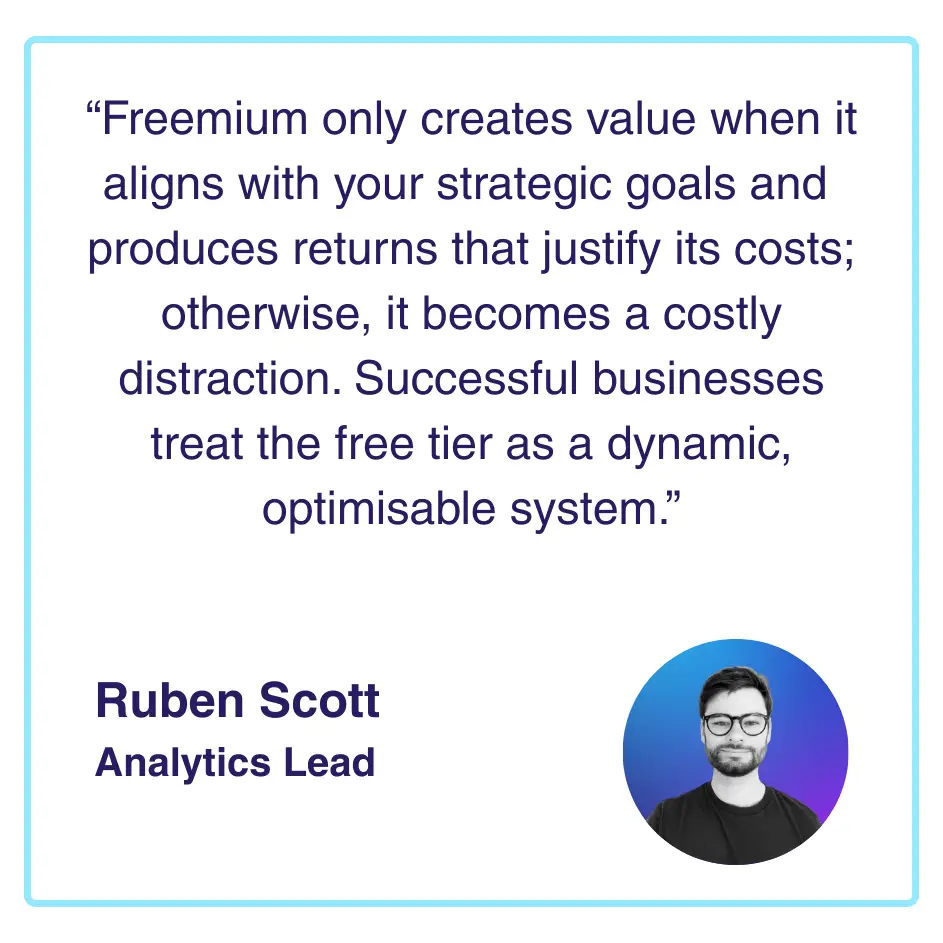
Perhaps most importantly, fixing freemium requires treating it as a dynamic system requiring continuous optimisation rather than a static offering you implement once. The companies with successful freemium run ongoing experiments, track comprehensive metrics, iterate based on data, and maintain intellectual honesty about whether freemium serves strategic objectives.

Conclusion
Freemium is not a universal solution to customer acquisition or a mandatory element of modern SaaS strategy. It’s a specific structural choice with clear costs, clear benefits, and clear requirements for success. Understanding these dynamics, through measurement, experimentation, and honest analysis, separates companies that use freemium strategically from those that offer it reflexively and wonder why it doesn’t produce the returns they expected.
The strategic question is not whether to offer freemium but whether you are prepared to operate it with the sophistication required to make it successful. This means treating the free tier as infrastructure requiring continuous investment and optimisation rather than a marketing gesture requiring minimal attention. It means building comprehensive analytics that connect free tier behaviour to long-term value. It means running systematic experiments that improve conversion mechanics over time. It means making difficult decisions about limit structures, feature gates, and segment prioritisation based on data rather than intuition.
Get In Touch
Our friendly team are always on hand to answer questions, troubleshoot problems and point you in the right direction.
