
App Advertising & Acquisition
At 173tech, we work with subscription businesses navigating the particular complexities of mobile app acquisition and retention. We have seen businesses underestimate the technical complexity of measuring app conversions accurately, leading to misallocated marketing budgets and flawed strategic decisions. This article explores the specific challenges facing app-based subscription businesses and provides practical guidance for companies seeking to build sustainable mobile acquisition strategies.
Unique Economics Of App-Based Subscriptions
Acquisition costs for app-based subscriptions are typically higher than for comparable web-based services, and there are several reasons for this. First, installing an app introduces an extra point of friction that web services simply don’t have. Users must not only decide to try the service, but also commit device storage and navigate app-store processes before they experience any real value. By contrast, web-based services allow users to begin trials immediately in their browsers, which generally leads to higher conversion rates.
Platform fees add another layer of complexity. Apple and Google take between 15% and 30% of subscription revenue processed through their payment systems, which can have a significant impact on unit economics. Web-based subscriptions, by comparison, allow businesses to retain a much larger share of revenue. While recent regulatory changes have introduced some alternative payment options, the vast majority of app-based subscriptions still rely on platform payment systems, making these fees a practical reality for most businesses.
App-based subscriptions also face a higher risk of users churning immediately after trial periods. Mobile users often behave differently from web users, with a tendency to download apps on impulse and abandon them just as quickly. This can result in businesses spending heavily to acquire subscribers who never intend to stay long-term, instead using free trials to access content or features before cancelling straight away.
These challenges become even more pronounced in highly competitive categories, where multiple apps offer similar functionality. Users frequently download several competing apps at once, trialling each before settling on a single service. This “serial trial” behaviour means that even users who are genuinely interested in the type of service you offer may never convert, either because their needs are met during trial periods or because another app ultimately feels like a better fit.
Taken together, higher acquisition costs, platform fees and increased churn risk mean that app-based subscription businesses need significantly higher lifetime values to reach profitability than their web-based counterparts. Many companies only fully appreciate these dynamics after substantial investment in app development and marketing, at which point they may find that their original unit-economic assumptions don’t hold up in the mobile environment.


App vs Web: Metrics
The metrics used to assess subscription performance differ significantly between app and web channels, making it difficult to apply familiar web-based measurement approaches in mobile environments.
Web-based subscriptions typically follow a simple, well-understood funnel, from website visit to trial sign-up to paid subscription, with each step easy to measure using established analytics tools. App-based subscriptions are more complex. An app install represents a higher commitment than a website visit, yet it is still far removed from conversion. Many users never open installed apps, while others drop off after a single session. The journey from discovery to subscription spans multiple stages, each with its own drop-off risks and measurement challenges.
In-app tracking adds further complexity. Web businesses can rely on cookies and pixels, whereas app tracking depends on mobile measurement partners, SDKs and platform-specific attribution frameworks. Privacy changes, particularly Apple’s App Tracking Transparency, have severely limited deterministic attribution on iOS, forcing most businesses to rely on less precise, probabilistic methods. As a result, reliably linking subscriptions back to advertising exposure has become far more difficult.
While Android currently allows more permissive tracking, increasing privacy controls suggest this advantage may not last. Measurement becomes even harder for businesses operating across both web and app, where connecting cross-platform user journeys requires sophisticated identity resolution. Combined with the fragmentation of the mobile ecosystem across devices, operating systems and regions, these factors make app-based subscription measurement significantly more challenging than its web-based equivalent.
Expert help is only a call away. We are always happy to give advice, offer an impartial opinion and put you on the right track. Book a call with a member of our friendly team today.
Creating Effective Advertising
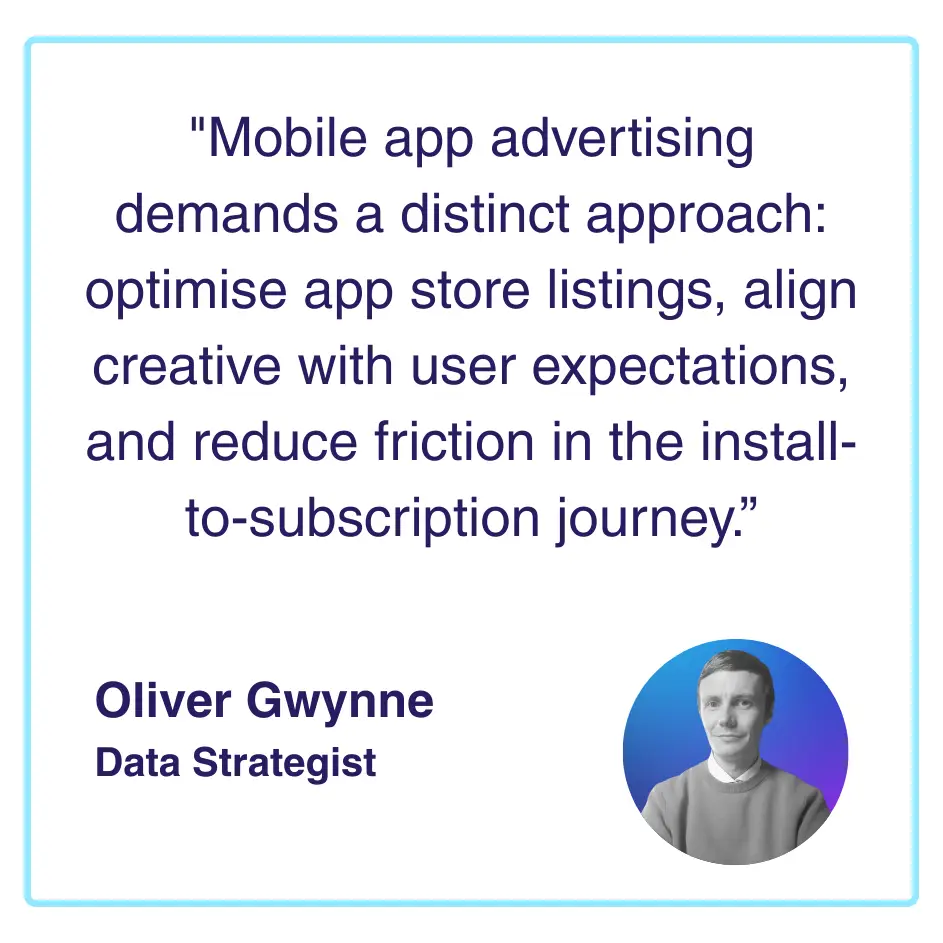
When users click advertisements, they arrive at your app store listing rather than directly experiencing your service. This intermediary step means that app store presentation: screenshots, videos, descriptions, ratings, and reviews, dramatically influences conversion rates from advertisement clicks to actual installs. Businesses often focus advertising creative optimisation whilst neglecting app store listings, creating disconnects where compelling advertisements drive traffic to unconvincing app store pages.
The relationship between advertisement creative and app store presentation requires careful co-ordination. Advertisements establish expectations about your service’s value proposition, features, and user experience. When users arrive at app store listings, those listings must reinforce and expand upon the promises made in advertisements.
Driving web traffic to encourage app installs versus driving app traffic to web properties presents distinct challenges. Web-to-app conversion showing web advertisements that encourage users to visit app stores, typically converts poorly because it requires users to leave their current context, navigate to app stores, find your listing, and initiate downloads. The friction here reduces conversion substantially compared to native app advertisements that enable installs directly from advertising platforms. Driving app users to web properties proves equally challenging. If your subscription purchase flow requires users to leave your app and complete transactions on mobile web browsers, you introduce significant friction and abandonment. Apple’s restrictions on linking to external payment systems whilst maintaining app store distribution further complicate these cross-environment conversion strategies.
The closed nature of mobile advertising ecosystems limits retargeting and cross-channel measurement in ways that frustrate marketers accustomed to web-based advertising flexibility. Web-based retargeting typically enables businesses to show advertisements to users based on specific website behaviours; visiting particular pages, abandoning shopping carts, viewing certain content. Mobile environments restrict these capabilities considerably, particularly on iOS where App Tracking Transparency limitations prevent most cross-app retargeting.This restriction on retargeting means that mobile advertising must achieve conversion more efficiently within initial touchpoints rather than depending on multi-touch remarketing campaigns that convert users over time. The “see advertisement, install app, subscribe” journey must occur with far less opportunity for intermediate retargeting than web environments typically allow. This reality demands more compelling initial value propositions and more efficient onboarding experiences, as businesses cannot rely on repeated retargeting touchpoints to gradually convince users.

Targeting Strategies
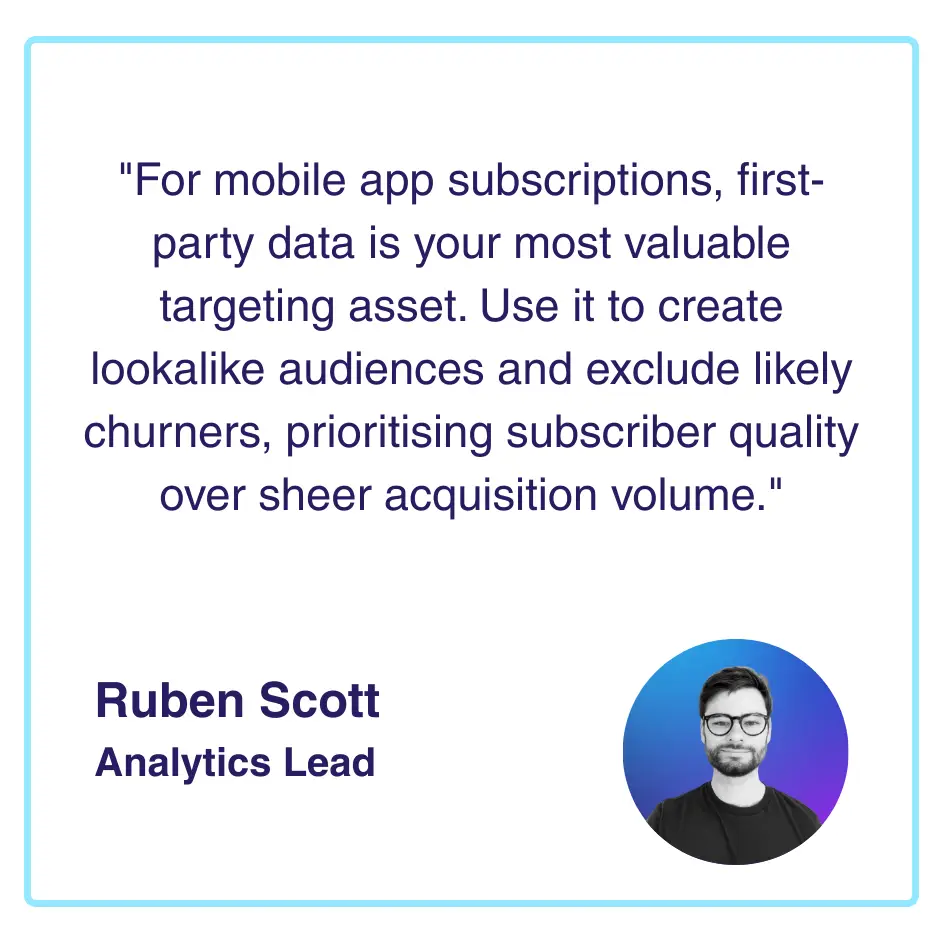
The growing importance of first-party data: First-party data is becoming critical for mobile app advertising as third-party tracking limitations reduce the effectiveness of alternative targeting methods. When cookie-based audiences and cross-app behavioural tracking are no longer reliable, data you own directly (such as email addresses, phone numbers and app user identifiers) becomes your most valuable asset. Mobile advertising platforms allow this data to be uploaded to create custom audiences, enabling precise targeting of existing customers or the exclusion of current subscribers from acquisition campaigns.
Building stronger lookalike audiences: Effective lookalike audiences depend on the availability of high-quality first-party data. Advertising platforms generate more accurate lookalikes when trained on larger seed audiences made up of known, high-value customers. This creates a strong incentive for app-based subscription businesses to capture customer information as early as possible, steadily building first-party data assets that support more advanced targeting over time.
The role of email addresses and phone numbers: Email addresses are especially valuable because they can be matched across both mobile and web environments. Collecting them during app registration enables email marketing, supports cross-platform user matching and helps create more complete customer profiles. Phone numbers offer similar benefits, particularly for SMS marketing and mobile-specific targeting capabilities.
Using app user identifiers for privacy-safe targeting: App user identifiers (anonymous IDs assigned by mobile operating systems) enable precise targeting within app environments even when other tracking methods are restricted. Businesses can upload lists of identifiers for subscribers or highly engaged users to advertising platforms for targeted campaigns or to exclude them from acquisition activity. This approach supports effective remarketing while remaining aligned with platform privacy frameworks.
Reducing one-off subscribers through behavioural insights: Reducing the number of users who churn immediately after free trials requires more nuanced targeting strategies. By analysing differences between short-term and long-term subscribers, businesses can identify signals that indicate poor fit, such as acquisition source, creative variation, geography or onboarding behaviour. Applying these insights helps improve subscriber quality, even if it reduces overall acquisition volume.
Balancing acquisition volume and subscriber quality: App-based subscription businesses must manage the trade-off between scale and quality. Broad targeting often delivers high install volumes and low cost-per-install metrics, but these users tend to convert less reliably and churn more quickly. More selective targeting typically increases upfront acquisition costs while delivering stronger lifetime value through improved retention.
Moving beyond short-term optimisation: Many businesses still optimise primarily for short-term metrics such as cost per install or trial conversion rate, without giving enough weight to long-term retention. This can create the illusion of growth while masking weak unit economics. More advanced approaches incorporate predicted lifetime value into acquisition decisions, accepting higher initial costs in exchange for more sustainable long-term revenue.

The Importance Of Early Email Capture
For app-based subscription businesses, capturing email addresses early in the user journey is one of the most strategically valuable actions, yet it is often delayed or overlooked.
Email as a persistent identifier: Email addresses provide a durable way to identify and communicate with users across devices, platforms and app lifecycles. Users frequently delete apps, change phones or disengage without cancelling subscriptions. Email allows businesses to maintain contact, support users and re-engage audiences that would otherwise be lost. Beyond communication, email addresses power key marketing capabilities. They enable custom and lookalike audiences, support identity matching across web and app environments, and underpin personalisation strategies that improve retention and lifetime value.
The cost of delaying email capture: Many apps wait too long to request email addresses, optimising for reduced friction at the expense of data capture. This results in losing visibility into users who engage briefly and abandon, a problem that is particularly acute in freemium models where most users never reach account creation. The most effective approach is to request an email address after users have experienced some real value, but before they fully explore the free offering. The optimal timing varies by product and should be tested, but often follows one or two meaningful interactions with core features.
Improving conversion through clear value: Email capture performs best when users understand the benefit. Prompts that highlight clear outcomes; such as saving progress, syncing across devices or receiving personalised recommendations, convert more effectively than generic requests. Thoughtful incentives can help, provided they attract genuinely interested users. Progressive disclosure works well for many apps: capture the email first, then request additional information as engagement deepens. Email verification should be applied selectively, balancing data quality against the risk of adding unnecessary friction.
Practical Recommendations
Successfully navigating the complexities of app-based subscription acquisition requires strategic approaches that acknowledge platform limitations whilst leveraging available capabilities effectively. The following recommendations reflect patterns we have observed in building sustainable mobile subscription businesses across various categories and scale levels.
Prioritise first-party data capture throughout the mobile user experience: Every interaction represents an opportunity to collect information that enables better targeting, personalisation, and retention. Email addresses provide the foundation, but phone numbers, preference information, usage patterns, and demographic data all contribute to building customer profiles that support sophisticated marketing and product strategies. Design your onboarding flow, feature gating, and premium upgrade paths to incentivise data sharing with clear value exchange rather than simply requesting information without apparent benefit to users.
Optimise your freemium funnel to demonstrate value rapidly whilst capturing data early: The timing of when you request email addresses, require account creation, or promote subscription upgrades dramatically affects both immediate conversion rates and long-term data asset development. Test various points in the user journey to identify optimal moments for these requests, recognising that the best timing balances immediate conversion optimisation against data capture for users who ultimately abandon without converting.
Invest heavily in app store optimisation: Treat the app store listing as an integral component of advertising strategy rather than treating it as separate from performance marketing. Your app store listing represents a critical conversion point that mediates between advertising investment and actual installs. High-quality screenshots demonstrating key functionality, compelling preview videos showing actual app usage, clear feature descriptions addressing user questions, and strong ratings from satisfied users collectively determine whether advertising traffic converts to installs. Regularly refresh app store creative to maintain relevance and test variations to optimise conversion.
Develop mobile-specific advertising creative rather than repurposing web assets: Mobile advertisement formats, viewing contexts, and user expectations differ sufficiently from web environments that creative designed for desktop rarely performs optimally on mobile. Vertical video formats, demonstration of actual app interfaces, clear value propositions visible within seconds, and platform-appropriate calls-to-action all improve mobile advertising performance. Test creative variations extensively, recognising that small improvements in click-through rates and conversion rates compound significantly across large-scale campaigns.
Build attribution that accommodates platform privacy restrictions: Whilst perfect attribution remains difficult in modern mobile environments, thoughtfully implemented measurement systems combining mobile measurement partners, server-side event tracking, and first-party data matching provide sufficient visibility for informed decision making. Accept that measurement will contain uncertainty but implement systems that minimise that uncertainty and make it visible in reporting rather than claiming false precision.
Design targeting strategies that balance audience scale with subscriber quality: Whilst broad targeting often delivers lower immediate acquisition costs, the long-term economics of subscription businesses depend on retention as much as acquisition. Analyse cohort retention patterns across different targeting approaches, creative variations, and traffic sources to identify which acquisition strategies deliver superior lifetime value even when immediate metrics appear less attractive. Shift budget toward these higher-quality acquisition channels even if doing so reduces overall growth rates, recognising that sustainable subscription businesses depend on retaining subscribers rather than constantly replacing churned users.
Implement re-engagement campaigns: Target users who install your app but never subscribe or who subscribe but exhibit declining engagement. Email addresses and push notification permissions enable outreach to users showing abandonment or churn warning signals. Automated campaigns addressing common abandonment reasons, highlighting new features, or offering incentives for re-engagement often reactivate users at far lower cost than acquiring new subscribers. The key lies in timing these campaigns appropriately, soon enough to remain relevant but allowing sufficient time for users to recognise independently that they miss your service.
Use first-party data strategically to improve advertising performance over time: As you accumulate subscribers and usage data, segment audiences by quality, identifying characteristics of high-lifetime-value subscribers versus those who churn quickly. Upload these high-quality customer segments to advertising platforms as seed audiences for lookalike targeting, progressively improving targeting accuracy as your data assets grow. This approach creates compounding advantages where successful subscription businesses develop increasingly efficient acquisition over time through better targeting whilst competitors struggle with static targeting capabilities.
Consider the full platform fee implications when evaluating subscription pricing and unit economics: Apple and Google’s 15 to 30% fees on in-app subscriptions dramatically affect profitability, particularly for lower-priced subscription tiers. Some businesses find that premium positioning with higher subscription prices becomes necessary in app environments to maintain acceptable margins after platform fees. Others implement alternative monetisation approaches—annual billing, consumable purchases, hybrid web-app payment flows—to reduce platform fee impact. Understanding these economics before launching app-based subscriptions prevents discovering unprofitable unit economics after significant investment.


Conclusion
App-based subscription businesses face more complex acquisition and retention challenges than their web-based counterparts. Higher acquisition costs, platform fees, attribution constraints and increased churn risk mean that sustainable economics are harder to achieve without deliberate, mobile-specific strategies.
At 173tech, we help subscription businesses navigate these challenges by building robust measurement systems, effective freemium funnels and targeting strategies that prioritise subscriber quality alongside acquisition efficiency.
Get In Touch
Our friendly team are always on hand to answer questions, troubleshoot problems and point you in the right direction.
